Independent Pest Control Company Acquisition & SBA Underwriting Financial Model
Underwrite an independent pest control acquisition the way an SBA lender will: build revenue from a recurring route book (accounts x annual value) with a route-density engine, separate the…
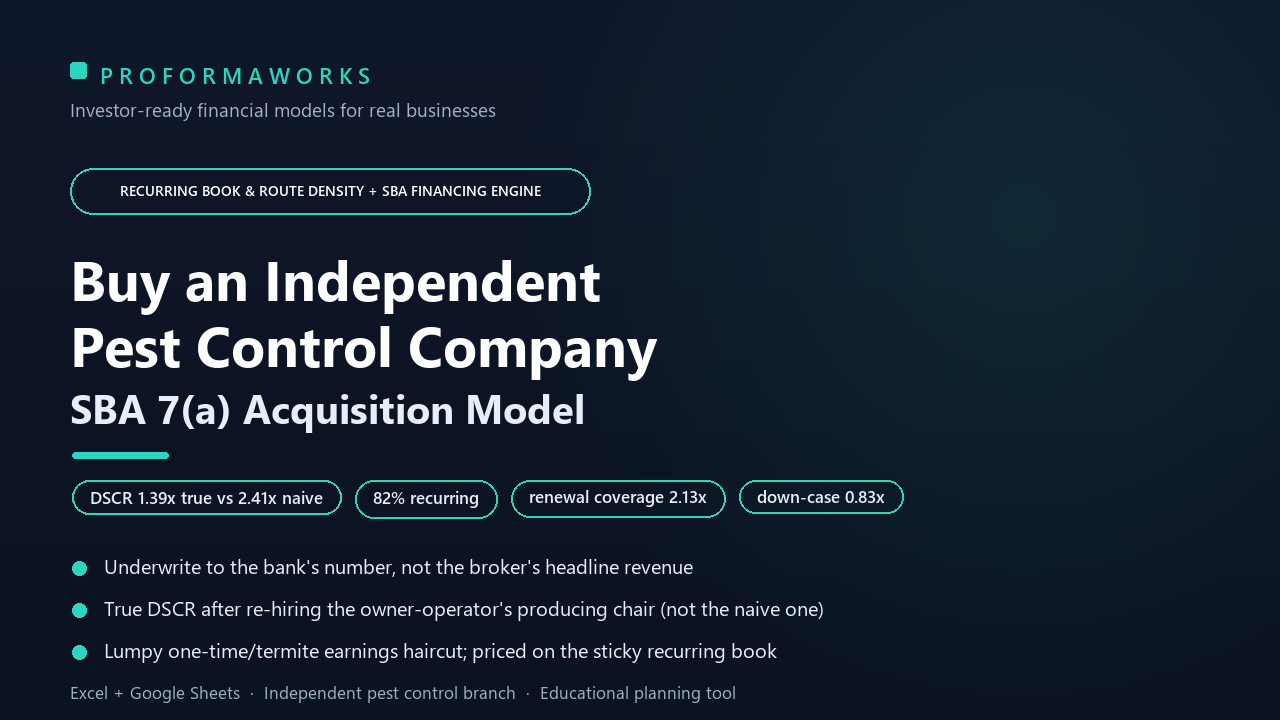
Buy an independent pest control company and underwrite it the way an SBA lender actually will — not the way the broker's revenue sheet wants you to. This is a lender-ready acquisition model for a single-branch pest control business, built around the two things a real underwriter tests and a broker quietly overstates: how much of the revenue is a recurring route book you can actually bank on, and what it costs to replace an owner who runs a route or sells.
A recurring route book and a route-density engine, not a guessed revenue line. Revenue is built bottom-up from what the business really is: recurring accounts (residential and commercial) times their average annual value, plus one-time and termite/WDO work. Then the route-density block — stops per technician per day, revenue per tech — makes the operational margin lever explicit, because in pest control density is what moves gross margin. The base case runs ~$1.70M revenue, 82% recurring, ~11 stops per tech per day and ~$155k revenue per tech.
Honesty part one — recurring vs one-time quality. One-time and termite jobs are real money, but they are lumpy, non-contractual, and do not deserve the multiple a sticky recurring route book earns. The model splits SDE into its recurring and one-time halves, prices each at its own multiple, and shows exactly how much a buyer overpays (~$146,920 on the base case) by applying the full recurring multiple to lumpy one-time earnings.
Honesty part two — the owner-operator replacement. In most single-branch companies the owner runs a route or is the top salesperson. If you (or your buyer) aren't going to sit in that seat, you must re-hire it. The model deducts that cost to reach Adjusted EBITDA and shows the TRUE DSCR (1.39x on the base case) right next to the NAIVE broker-style DSCR (2.41x). The gap is the owner's own production — exactly what separates a financeable route business from one that looks great on the CIM and gets declined.
What you get:
- Recurring Book & Route Density Engine — recurring accounts × annual value by segment, one-time/termite revenue, the recurring-% quality metric, and the route-density block (stops per tech per day, revenue per tech) that drives margin.
- SDE & Valuation — SDE from revenue less materials, field labor and operating expense; the recurring-vs-one-time quality panel; the owner-operator replacement; Adjusted EBITDA; and the price at your SDE multiple.
- SBA 7(a) capital stack — buyer equity + seller note + loan (≈80/10/10), with a full-standby vs amortizing seller-note toggle that moves DSCR from declined to bankable.
- DSCR & Debt gate — the true DSCR, the naive DSCR, debt yield, the recurring-earnings coverage (2.13x of debt service), and a down-case DSCR of 0.83x when customer churn spikes — the sector's #1 value risk, priced honestly.
- 5-year P&L, Returns & Exit, Dashboard — cash-on-cash, equity multiple, and a DSCR bankability grid across price and rate.
- 3-way profile toggle — Balanced / Residential-Route-Dense / Commercial-&-Termite-Heavy reloads retention, the multiple, working capital and capex.
- In-depth PDF user guide + a Benchmarks & Sources tab with every assumption's range and source.
Honest by design. SDE margin held at a realistic ~30% and Adjusted EBITDA ~18% after replacing the owner's route; a searcher prices at ~2.5-3.0x SDE, and the PE roll-up's 7-17x EBITDA is NOT sold as your return; one-time revenue is haircut, not capitalized at the recurring multiple; and no IRR is headlined, because on one small deal it is hostage to the exit multiple. Machine-verified: 67 automated checks across three engines, zero errors. Works in Excel and Google Sheets — no macros.
Educational planning tool, not financial, legal, tax or investment advice. Verify the seller's route revenue, customer retention/attrition history, technician employment and non-competes, and your SBA term sheet before relying on any number.