Search Fund / Independent Sponsor: Multi-Acquisition Holdco & LP Waterfall Model
You can underwrite one acquisition on a single sheet: price, debt, cash flow, coverage, exit.
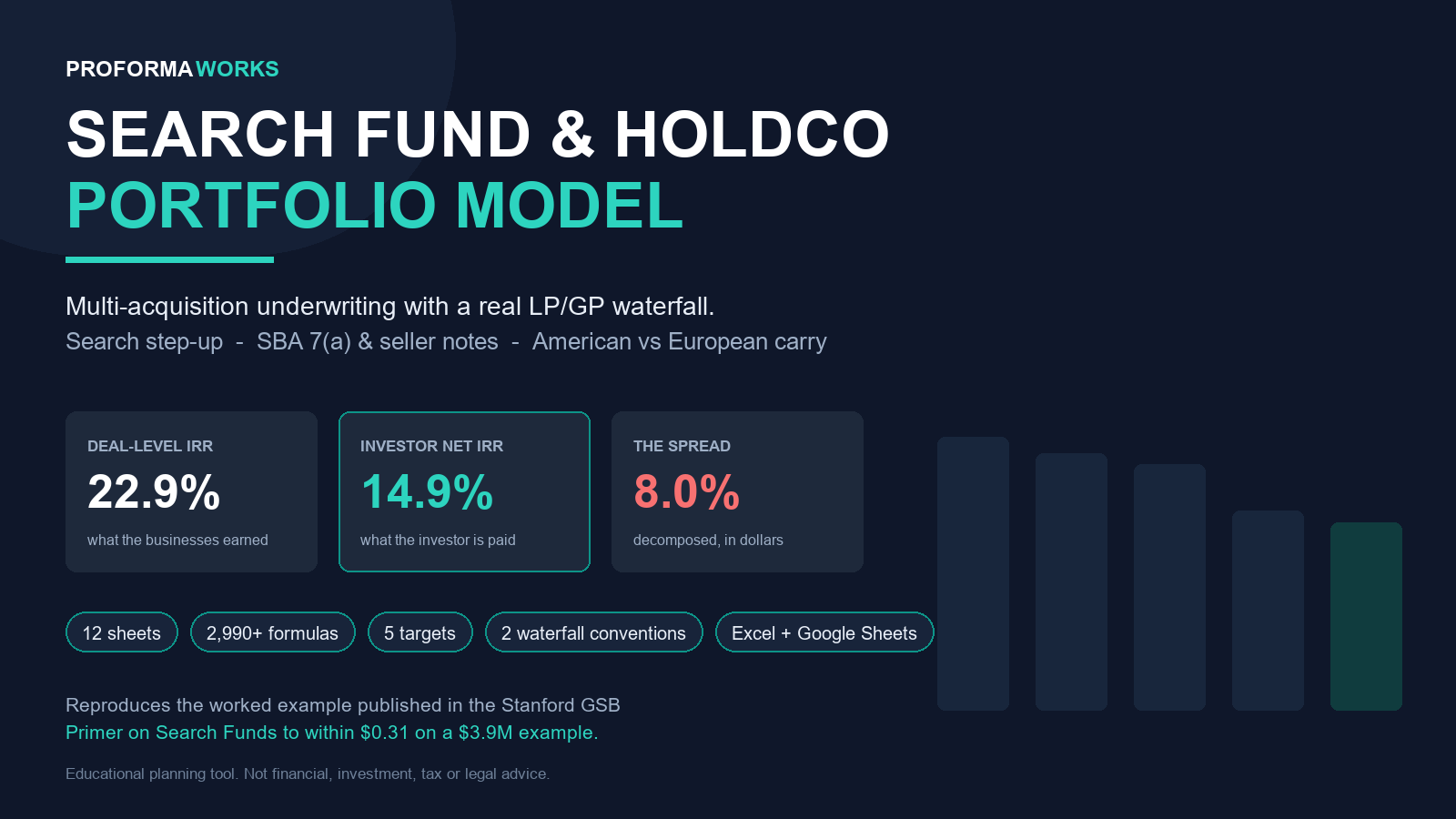
You can underwrite one acquisition on a single sheet: price, debt, cash flow, coverage, exit. Do it five times and you still have not modelled a fund — because three things exist only above the deal level, and they are exactly where the investor's money goes.
This model puts those three things in front of you. The search phase, where capital is spent for years before anything is bought and some of it buys nothing at all, then converts into equity at a step-up — typically 150% of what was invested, which is capital and preferred return standing in front of the promote. The waterfall: return of capital, preferred return, catch-up, promote, with both conventions computed on the same cash every time the file recalculates — whole-of-fund (European) and deal-by-deal (American), with a clawback switch. And the order of events, because capital called late earns more on the same dollars, and a promote paid early on a winner, before a loser is recognised, may never come back.
The output is a six-line bridge, in dollars, that adds up exactly: cash generated by the businesses, less the equity invested in them, less the search phase, less management fees, less transaction fees, less the promote — leaving the investor's net profit. Beside it is an IRR ladder from the deal-level return to the investor's net return, presented without pretending the rungs add up, because an internal rate of return is not a sum of parts. Any model that shows you an additive IRR bridge is showing you an arithmetic that does not exist.
Two propositions you can test rather than take on trust. Deal-by-deal without a clawback, with one losing deal in the portfolio, pays the sponsor more than the whole-fund entitlement — and the excess is precisely what the investors lose. Deal-by-deal with a full clawback converges to the whole-fund result in total dollars, leaving a difference that survives only in timing. Both are computed side by side, on the same cash flows, in the default case.
At the deal level: five targets, each with its own entry multiple, senior debt, seller note with a standby period where interest accrues instead of being paid, growth, capex, cash taxes, exit and coverage ratio. SBA 7(a)'s published caps — $5 million maximum loan, 75% guaranty, ten-year maximum maturity outside real estate — are checked against your inputs and flagged when breached, because amortising acquisition debt over twenty-five years makes almost any price work on paper and that financing does not exist for a goodwill deal.
The search fund structure is modelled properly, not approximated: the two-stage capital raise, the step-up on conversion, and the searcher's equity in three tranches — one at closing, one vesting over four years of employment, one on performance hurdles that begin at a 20% net IRR to investors and top out around 35%.
The default portfolio contains one target that is never acquired and one acquisition that loses money, because the published record says roughly one search fund in three never acquires and roughly one acquisition in four has lost money for investors. A base case where everything works would contradict its own evidence.
The waterfall engine reproduces the worked example published in the Stanford GSB Primer on Search Funds to within the rounding of the printed text — the comparison is on its own sheet, so you can check it rather than trust it.
Twelve sheets, 2,996 formulas. Excel and Google Sheets, no macros, no external links, no iterative calculation. Includes a 7-page user guide. Every benchmark carries its source and a reliability tag; where no benchmark exists — entry multiples, exit multiples, sponsor fee levels — the sheet says so instead of inventing one.