ProformaWorks
Sign in Create an account

You do not need an account to buy — it just keeps your downloads in one place.

Operating Solar (+BESS) Asset Acquisition & Tax-Equity Flip Underwriting Model

Operating Solar (+BESS) Asset Acquisition & Tax-Equity Flip Underwriting Model

Most solar financial models forecast a plant that does not exist yet. This one underwrites a plant that does — and that changes everything, because an operating asset has a production record, and the record beats any forecast.

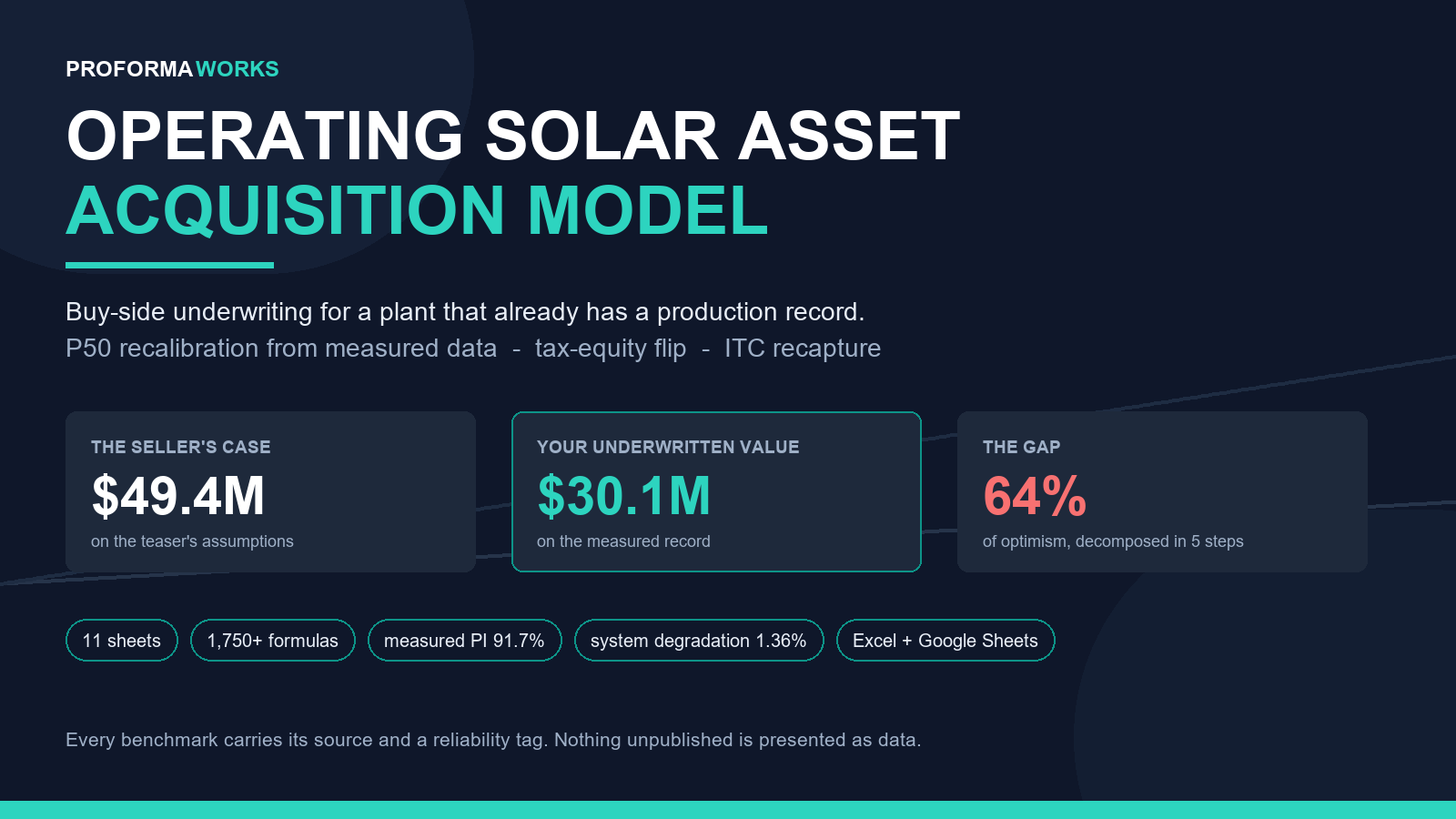
The model answers a single question: what are you actually buying if you take over this plant in year N of its life? It prices the same asset twice. The seller's case runs on the assumptions in the teaser: the original P50 uncorrected, degradation at the module-warranty rate, a flat merchant value factor, no inverter reserve, and the seller's own discount rate. The underwritten case runs on what survives diligence: the P50 recalibrated from the measured record, system degradation regressed from that same record, a merchant value factor that declines as solar penetration rises, a funded inverter reserve, and your required return. The distance between the two is decomposed into five exact steps, so you see not only that the price is wrong but what it is wrong about.

Three engines no competing model contains. First, a five-step P50 recalibration: weather-normalise the metered record against TMY, separate recurring losses from genuine one-offs, and regress the log of normalised output against age — the slope gives you measured system degradation, the intercept gives you the Performance Index. The US fleet delivers about 8.6% less than its own weather-adjusted P50; on an operating asset you do not have to assume that number, you can measure it. Second, a tax equity partnership flip waterfall: pre-flip and post-flip allocations of cash and of tax benefits held separately, the flip date determined from the investor's target after-tax IRR, and the statutory five-year minimum enforced. Buying sponsor equity before the flip and after the flip are two different assets. Third, an ITC recapture ladder: the 20%-per-year vesting scale, the two-thirds partnership threshold, and the exposure sized by the form of your transaction.

Also modelled: PPA mark-to-market against the current market, a merchant tail discounted separately at your rate plus an uplift, mid-life inverter reserve, back-leverage with contracted and merchant coverage tests, and the operating leverage of a mature asset — where opex runs over a third of revenue rather than the 22% of a new plant.

Every benchmark carries its source and a reliability tag. Where no benchmark exists — the discount rate, the value-factor decline rate, inverter replacement timing, transaction costs — the sheet says so instead of inventing one. The MACRS recovery period is deliberately an input, because the sources contradict each other after OBBBA and a model that asserts a contested tax position is worse than one that asks you to choose.

Eleven sheets, 1,752 formulas. Excel and Google Sheets, no macros, no external links. Includes a 7-page user guide. Tax law as published at 18 August 2026.

Other models in this industry