Seller Note on Full Standby in an SBA 7(a) Acquisition: Rules, Cash at Closing and DSCR, Worked Example
A seller who "carries a note" can lower the cash you bring to closing on an SBA 7(a) acquisition. But the version of that idea many buyers and brokers still describe, with the seller note on standby for 24 months and then paid alongside the bank, no longer counts as equity. Under the current SBA rulebook, a seller note counts toward your equity injection only if it is on full standby: no principal and no interest paid for the entire term of the 7(a) loan.
Below: what full standby means, how much of the injection it can cover, and one hypothetical $1.2 million acquisition run through five structures, with every number reproducible. SBA and Federal Reserve facts are linked and dated.
Educational content, not advice. This article explains SBA rules for planning purposes. It is not financial, legal, tax or lending advice. No article or spreadsheet can get a loan approved, and lenders add their own credit policies on top of SBA rules. Confirm every point with your lender and your attorney.
If you want the wider picture of the rules that took effect on October 1, 2026, start with our overview of SBA 7(a) rules for business buyers after October 1, 2026. This article goes deep on one piece of it: the standby note.
What "full standby" means in SBA terms
SBA's lending rules for 7(a) loans live in SOP 50 10. The current version, SOP 50 10 8.1, took effect on October 1, 2026. Appendix 15, "7(a) Changes of Ownership," says:
- "Seller debt that is subordinated to the Lender and on full standby (no payments of principal or interest for the term of the 7(a) loan) may be considered as equity for SBA's purposes."
- The lender "must use SBA Form 155 or its own equivalent Standby Agreement form, and a copy of the Note must be attached to the standby agreement and included in the credit file."
- "The standby debt may accrue interest and may be added to the standby debt and amortized after the 7(a) loan is paid in full."
- The standby creditor must subordinate its lien rights to the lender and "take no action against Borrower or any collateral securing the Standby Debt without Lender's consent."
- "The provider of standby debt may not take an equity investment in the business."
In practice:
- The standby period is the term of the 7(a) loan. A change-of-ownership 7(a) loan "must not have an amortization that exceeds 10 years" (the SOP's exceptions cover real estate and special purpose properties), and 7(a) loans "may not have a balloon." On a typical business-only deal, the seller waits about 10 years for the first dollar.
- The note is not interest-free. Interest can accrue and be paid later. That accrued interest becomes the buyer's bill once the bank is repaid.
- The seller is fully behind the bank and cannot collect or enforce while the 7(a) loan is outstanding.
SBA Form 155, the Standby Creditor's Agreement, has four check boxes. They range from "To accept no further payments on the Standby Loan until Lender's Loan is satisfied" to interest-only payments, principal and interest payments, or payments "beginning on" a set date (SBA Form 155). Only the first box matches the SOP's definition of full standby. The others describe notes that pay something while the 7(a) loan is outstanding. Check which box is ticked before you count the note as equity.
How much of the equity injection a standby note can cover
For an Initial Acquisition, meaning an outside buyer becoming the new majority or largest owner, SOP 50 10 8.1 requires an equity injection of 10% of total project costs, and it "cannot be reduced or eliminated." Total project costs are "all costs required to become operational, regardless of the source of funds," which can include working capital and closing costs, not just the price.
The SOP sorts equity into two buckets:
- Unlimited sources: cash that is not borrowed, cash from a personal loan repaid from outside the business, grants with no clawback, and verified eligible prepaid expenses.
- Limited sources: standby debt, seller debt on full standby, and non-controlling minority equity investments. These, "whether individually or in the aggregate, may provide no more than half of the required Equity Injection."
So on a typical deal, a full-standby seller note can cover at most 5% of total project costs (half of the 10%). The other half comes from your own unborrowed money or another unlimited source.
The new exception for veterans (November 11, 2026)
On November 10, 2026, SBA published Procedural Notice 5000-883564, effective November 11, 2026. For a "Veteran Business Acquisition," the limited sources "may provide up to 100 percent of the required equity injection." It applies when, right after closing, one or more Veterans (as defined in Appendix 3 of the SOP) directly or indirectly own at least 50% of the business. The flexibility is temporary. It covers loans that receive an SBA loan number between November 11, 2026, and 11:59 PM Eastern on September 30, 2027.
The notice "changes only the permitted mix of equity sources." The 10% minimum still applies, and seller debt must still be on full standby for the term of the 7(a) loan. SBA's announcement describes it as letting veteran buyers raise the full 10% "from permitted outside sources."
Why "24 months on standby" no longer works
The 24-month idea comes from an older rulebook. SOP 50 10 7.1 (effective November 15, 2023) let seller debt count as equity if, "for the first 24 months of the 7(a) loan," it was on full standby, or on interest-only partial standby with conditions. SOP 50 10 8 (effective June 1, 2025) changed that: seller debt could not count "unless it is on full standby for the life of the SBA loan, and it does not exceed half of the SBA-required equity injection." SOP 50 10 8.1 kept the full-term standard.
A note with a 24-month standby can still be part of a deal. It just isn't equity. Your full 10% then has to come from other sources, and the lender has to count the note's payments as debt.
The worked example: one deal, five structures
The deal is hypothetical, and every input below is an assumption. The SOP rules and the prime rate are the only sourced numbers.
| Input | Value | Basis |
|---|---|---|
| Purchase price (asset deal, leased premises) | $1,200,000 | Assumption |
| Working capital funded at closing | $60,000 | Assumption |
| Closing and due-diligence costs | $40,000 | Assumption (SBA guaranty fee excluded) |
| Total project costs | $1,300,000 | Sum |
| Required equity injection (10%) | $130,000 | SOP 50 10 8.1, Appendix 15 |
| Maximum from limited sources (half) | $65,000 | SOP 50 10 8.1, Appendix 15 |
| Seller's discretionary earnings (SDE) | $360,000 | Assumption, documented |
| Market-rate salary for the person running it | $110,000 | Assumption |
| Cash flow available for debt service | $250,000 | SDE minus salary |
| 7(a) rate | 10.00%, 10-year amortization | Assumption: prime of 7.00% plus the 3.0% maximum spread |
| Seller note rate | 7.00% | Assumption |
| Business valuation | $1,200,000 | Assumption: supports the price |
On the rate: the Federal Reserve's H.15 release of November 19, 2026 shows the bank prime loan rate at 7.00% on each business day from November 12 to 18, 2026. SOP 50 10 8.1 caps the variable-rate spread at prime plus 3.0% for 7(a) loans of $350,001 and higher. We use that 10.00% ceiling to stay conservative. Your lender may quote lower, or a fixed rate.
On cash flow: a lender rebuilds cash flow from tax returns, not from the broker's SDE. Our guide to how an SBA lender rebuilds SDE walks through that. Here we assume the $250,000 survives that review.
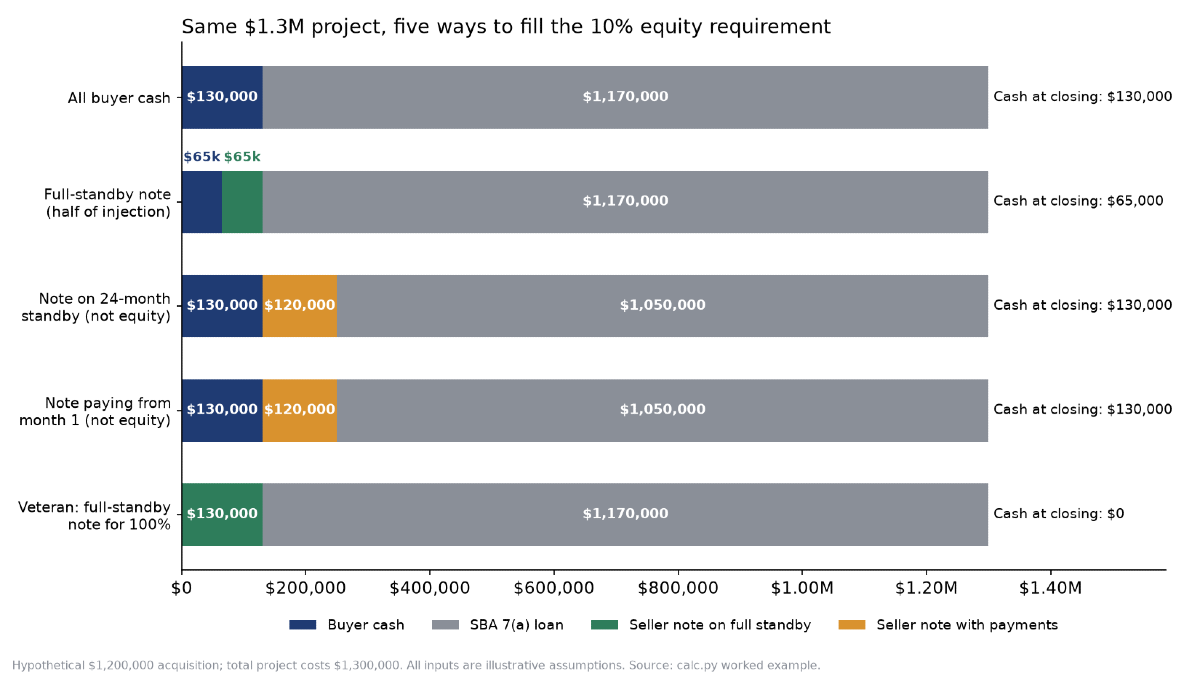
| Structure | Buyer cash | Seller note | Counts as equity | 7(a) loan | Underwritten debt service | DSCR |
|---|---|---|---|---|---|---|
| A. All buyer cash | $130,000 | none | $130,000 cash | $1,170,000 | $185,540 | 1.35x |
| B. Full-standby note, half the injection | $65,000 | $65,000 | $65,000 cash + $65,000 note | $1,170,000 | $185,540 | 1.35x |
| C. $120,000 note, 24-month standby, then 8 years of payments | $130,000 | $120,000 | $130,000 cash only | $1,050,000 | $189,084 | 1.32x |
| D. $120,000 note paying from month 1, 10 years | $130,000 | $120,000 | $130,000 cash only | $1,050,000 | $183,230 | 1.36x |
| E. Veteran buyer, full-standby note for 100% | $0 | $130,000 | $130,000 note | $1,170,000 | $185,540 | 1.35x |
All five structures clear SOP 50 10 8.1's 1.25x debt service coverage minimum for an Initial Acquisition, measured on the last fiscal year or the average of the last two. For C and D, total debt including the paying seller note is $1,170,000. That is within the $1,200,000 valuation, as the SOP requires: "The total debt eligible to support a change of ownership transaction (including seller debt that is not on full standby) is limited to the business valuation amount."
What full standby changes: your cash at closing
Compare A and B. The 7(a) loan is the same $1,170,000 and the monthly payment is the same $15,462. The only difference is that the seller's note replaces $65,000 of your cash. That is what a full-standby note does. It substitutes for buyer equity, not for bank debt.
Under the veteran flexibility (E), the full $130,000 injection can come from a full-standby seller note, so the buyer brings no cash toward the required injection. The bank loan is still $1,170,000.
What full standby does not change: DSCR
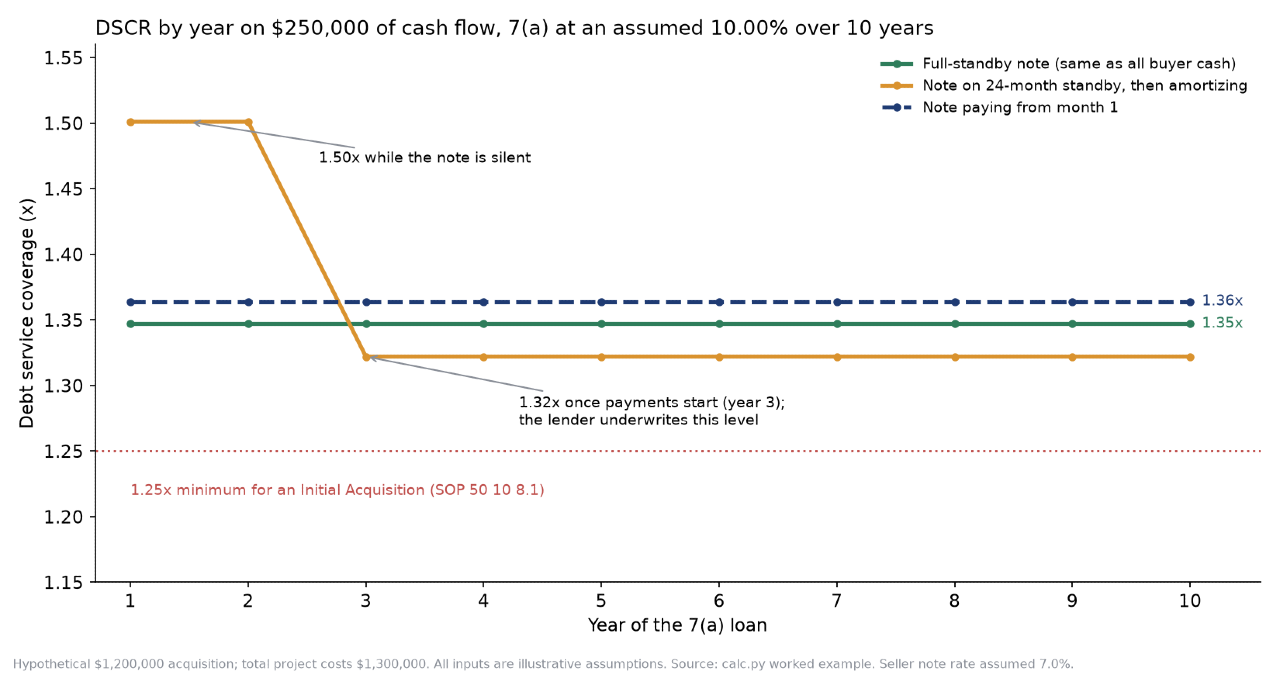
The SOP defines debt service as "the future required principal and interest payments on all business debt inclusive of new SBA loan proceeds." A full-standby note has no required payments while the 7(a) loan is outstanding, so it adds nothing to debt service. That gives B the same 1.35x coverage as A. It is no worse than paying all cash, and no better.
A full-standby note does not fix a deal that fails the coverage test. In B, cash flow can fall only about 7.2% before coverage hits 1.25x, the same cushion as A. If coverage is the problem, the fixes are a lower price, more equity to shrink the loan, or a seller note that replaces bank debt, as in D.
Notes that are not on full standby: C and D
In D, the seller note pays from month 1, so it doesn't count as equity and you still bring $130,000. But it replaces $120,000 of 7(a) debt. At an assumed 7% over 10 years it costs $16,720 a year, against about $19,030 a year for the same $120,000 of 7(a) debt at 10%. Coverage edges up to 1.36x. That result depends entirely on the seller accepting a lower rate and a 10-year term. A seller note at 10% over 5 years would push coverage the other way.
C is the old 24-month structure. During the first two years, coverage looks great: 1.50x. In year 3 the note wakes up. Its balance has grown to $137,977 with accrued interest, and it costs $22,574 a year over the remaining eight years. Coverage drops to 1.32x for years 3 to 10. Our model assumes a lender would test coverage at that full post-standby payment level, because SBA counts future required payments. For purchase debt that is not on full standby and pays interest only, the SOP is explicit that the lender "must apply an amortization that does not exceed 10-years." Assume your lender underwrites the year-3 number, not the year-1 number, and confirm it with them.
What happens when the standby ends
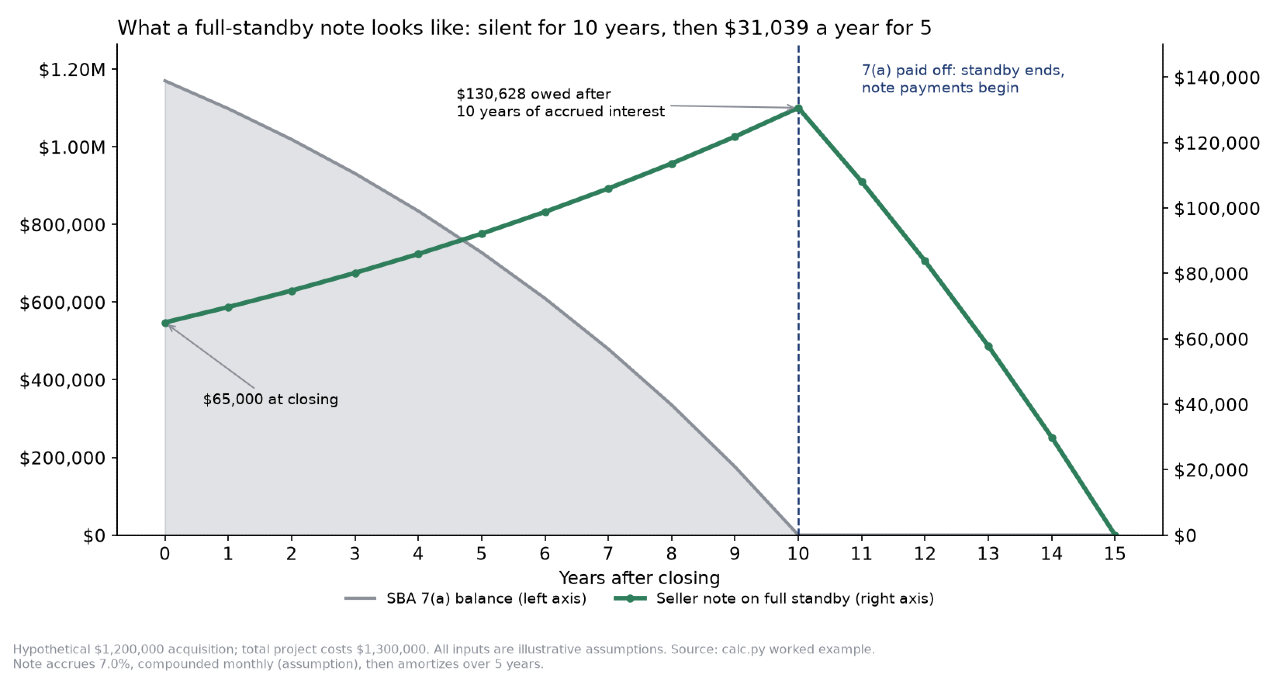
On a full-standby note, standby ends when the 7(a) loan "is paid in full." In our example that is the end of year 10. The note then starts paying. That is a new bill, and it is bigger than the original note.
In B, we assumed 7% interest compounding monthly for 10 years. That is an assumption. Many notes use simple interest, and your note's wording decides. Under it, the $65,000 note grows to $130,628 by the time the bank is repaid. Amortized over five years at 7%, that is $31,039 a year, and $155,195 in total payments to the seller for a $65,000 note. With simple interest, the balance at year 10 would be $110,500 instead.
Will the business handle it? Against $250,000 of flat cash flow, $31,039 a year is about 8.05x coverage, because the $185,540 bank payment is gone. Even with cash flow down 30%, coverage would be about 5.64x. No SBA coverage test applies at that point, since the 7(a) loan is gone. The "re-test" is your own budget, and the real risk is elsewhere:
- Selling early. If you sell the business in year 6, the 7(a) loan normally has to be dealt with at closing, and the note's terms decide what happens to the accrued balance. Write that into the note now.
- Prepaying the 7(a). Repaying the bank early ends the standby early, so the note starts paying sooner. Model that before you prepay.
- The veteran case doubles the bill. In E, a $130,000 standby note grows to $261,256 by year 10, or $62,078 a year for five years. The cash saved at closing comes back later with interest.
A seller should also know that refinancing a standby note with SBA money later is not easy. SOP 50 10 8.1 says seller debt from a change of ownership can be refinanced only after it "has been in place and current for 36 months." Another passage reads "in place and current (not on standby) for at least 36 months." The 36 months was 24 months under SOP 50 10 8. A note on full standby makes no payments, so a seller should not count on being refinanced out early.
How to negotiate a full-standby note
A full-standby note is a hard ask for a seller: up to 10 years of waiting, behind the bank, with no enforcement rights. Useful terms to discuss with your attorney:
- Size it to what actually counts. On a non-veteran deal, the amount that counts as equity is capped at half of the required injection ($65,000 here). A larger standby note can still be in the deal, but it won't reduce the cash you must bring below half of the 10%.
- Interest: rate and method. Simple or compound accrual is the difference between $110,500 and $130,628 in our example. Put the method in writing.
- Repayment after the 7(a) is repaid. Set the amortization period, or a lump-sum date, in the note so neither side is surprised in year 10.
- The right form. Make sure Form 155, or the lender's equivalent, shows the "no further payments" option and that the note is attached.
- The seller's exit. In an Initial Acquisition the seller cannot stay as an owner, officer, director or employee. The seller can work as a consultant for no more than 24 months in total. The provider of standby debt also "may not take an equity investment in the business."
- Price above valuation. If the price exceeds what the business valuation supports, the SOP says "the difference must be made up by equity." It also allows additional limited equity sources in that case, but "any additional funds provided must be on full standby." Ask your lender exactly how it applies both rules to your deal.
FAQ
Can a seller note on standby for 24 months count toward my down payment? Not under SOP 50 10 8 or 8.1. It counts only if it is subordinated and on full standby for the whole term of the 7(a) loan. The 24-month version came from SOP 50 10 7.1.
Can a veteran use a seller note for the entire 10%? For a Veteran Business Acquisition with an SBA loan number issued from November 11, 2026, through September 30, 2027, limited sources, including a full-standby seller note, may cover up to 100% of the required injection. The 10% minimum itself does not change.
Run your own structure
The Small Business Acquisition (ETA) Underwriting Financial Model is a 10-sheet Excel workbook, Google Sheets-compatible, that lays out a three-part capital stack (your cash, a seller note and the SBA 7(a) loan). It has a toggle that switches the seller note between full standby and amortizing, and a DSCR test computed after a market-rate operator salary. Use it to see how a standby note moves your cash at closing and your coverage before you talk to a lender. It does not get a loan approved, and your lender's credit decision is what counts.
Disclaimer: ProformaWorks articles and models are educational planning tools, not financial, legal, tax or lending advice. The example above is hypothetical, and its inputs are assumptions. SBA rules change, and a temporary notice like the veteran flexibility has an end date. Confirm every requirement against the current SOP 50 10 and with your lender before you sign a letter of intent or a note.
Sources
All documents were checked on November 20, 2026.
- SBA, SOP 50 10: Lender and Development Company Loan Programs, document page listing Version 8.1 with Technical Updates (effective October 1, 2026), Version 8 (effective June 1, 2025) and Version 7.1 (effective November 15, 2023). Full text of 8.1: Appendix 15 (equity injection, sources of equity, standby debt agreements, seller debt, DSC, total debt and valuation, 10-year amortization, seller exit, refinancing), Section B (definition of debt service) and Appendix 18 (interest rates).
- SBA, Procedural Notice 5000-883564, Update to Minimum Equity Requirement for Veteran Business Acquisitions, published November 10, 2026, effective November 11, 2026.
- SBA, press release of November 9, 2026 on equity flexibility for veterans' acquisitions.
- SBA, Form 155, Standby Creditor's Agreement.
- Board of Governors of the Federal Reserve System, H.15 Selected Interest Rates, release of November 19, 2026 (bank prime loan 7.00%, November 12–18, 2026).
- eCFR, 13 CFR 120.150, SBA's lending criteria (the detailed equity and standby rules are in SOP 50 10, not in the regulation text).
Keep reading
You might also like
How an SBA Lender Rebuilds SDE (and Why Broker Add-Backs Fail the DSCR Test)
A broker's SDE is not the cash flow an SBA lender will finance. On an initial acquisition, the lender rebuilds EBITDA from the seller's tax returns, verified against IRS transcripts, keeps only documented add-backs, and tests 1.25x debt service coverage. Here is how that math works, and where CIM add-backs usually break.

SBA 7(a) Rules for Business Buyers After October 1, 2026
SOP 50 10 8.1 consolidates the change-of-ownership rules into Appendix 15 and raises the bar for first-time buyers. Here is what changed, a line-by-line HVAC example that bridges SDE to EBITDA, and the traps that break deals at the lender's desk.
Buying a Laundromat: Does the Lease Outlast the SBA Loan, and Do the Machines?
Before buying a laundromat, put three clocks side by side: the lease, the 10-year SBA 7(a) loan and the machines. This guide rebuilds a hypothetical 30-washer store from vend prices and turns, checks that revenue against the water bill, tests the lease against SBA SOP 50 10 8.1, and shows how an aging fleet changes the price a buyer can support at 1.25x DSCR.