Buying a Laundromat: Does the Lease Outlast the SBA Loan, and Do the Machines?
Most laundromat listings sell the same story: self-service customers, no inventory, no receivables, few employees. Much of that is true. The Coin Laundry Association (CLA) describes coin laundries as businesses that "have no inventory or receivables" and that "generally occupy the retail space on long-term leases (10-25 years)" (CLA industry overview). That second point matters most when you are buying a laundromat with an SBA 7(a) loan. The washers, dryers, plumbing, venting and water heaters are bolted into a space you don't own, and you will pay for them over 10 years.
So a buyer has three clocks to line up:
- The lease. How many years are left, and which renewal options can you exercise on your own?
- The loan. For a business acquisition with no real estate, an SBA 7(a) loan runs up to 10 years.
- The machines. How many of them will need replacing before the loan is paid off, and who pays?
This guide works through all three on one clearly hypothetical store. Every input is an assumption unless it links to a source. If you want the SBA rules in full, see our guide to SBA 7(a) rules for business buyers after October 2026. This piece only covers the rules that touch a laundromat.
What the market data says first
Sale prices and earnings. BizBuySell analyzed 855 laundromats sold on its platform from 2021 through 2025. The median sale price was $250,000, median revenue $219,878 and median owner earnings (seller's discretionary earnings, or SDE) $76,560. Sold businesses went for 2.72x SDE at the lower quartile, 3.50x at the median and 4.50x at the upper quartile. The average earnings multiple rose to 4.12x in 2025 (BizBuySell laundromat valuation benchmarks, as shown on November 22, 2026). The CLA puts the usual range at "between three and five times the net cash flow for most transactions."
Store size and costs. In the CLA's 2024 Laundry Industry Survey, based on 377 respondents who own at least one self-service store and reporting 2023 results, the average store had 36.5 washers and 30.4 dryers. Mean gross revenue was $334,000 and the median was $335,000. The median store spent 20% of gross revenue on utilities, and median rent was 18% of gross revenue (CLA 2024 Laundry Industry Survey). The sample came from CLA members and trade-magazine subscribers, with a 6% response rate, so treat these figures as context, not a benchmark for your store.
Machine life. The CLA lists an "accepted standard of useful life" of 10 to 15 years for front-load washers (18 to 50 lb), dryers (30 to 60 lb), heating systems and coin changers, and 5 to 8 years for top-load washers. It adds that this "will vary upon usage, sales volume and maintenance."
Financing cost. The bank prime rate was 7.00% in the Federal Reserve's H.15 release dated November 20, 2026 (Federal Reserve H.15). For 7(a) loans over $350,000, SBA caps variable rates at the base rate plus 3.0% (SBA 7(a) terms), or 10.00% today. This example uses 10.00% as the rate throughout. It is not a quote. Smaller loans have higher caps (base plus 4.5% for $250,001 to $350,000), so a lender could legally charge more on the smaller loans below.
The hypothetical store: 30 washers, 32 dryers, some wash-dry-fold
The store has 2,600 square feet, is attended 60 hours a week and is open 364 days a year. It runs a small wash-dry-fold (WDF) service. Vend prices are set slightly above the CLA survey's national means ($3.57 for 18 to 24 lb front-loaders, $5.00 for 30 to 35 lb, $6.32 for 40 to 49 lb, $8.16 for 50 to 60 lb and $10.75 for 75 to 80 lb).
Revenue, machine by machine
Don't start from the monthly total on the seller's P&L. Start from the machines. Count, vend price and turns per day give you washer revenue. Each wash load then produces dryer spend.
| Washer group | Units | Vend price | Turns/day | Loads/yr | Washer revenue | Dryer revenue it feeds |
|---|---|---|---|---|---|---|
| 20 lb front-load | 12 | $3.75 | 4.0 | 17,472 | $65,520 | $30,576 |
| 30 lb front-load | 6 | $5.25 | 3.5 | 7,644 | $40,131 | $15,288 |
| 40 lb front-load | 6 | $6.50 | 3.2 | 6,989 | $45,427 | $17,472 |
| 60 lb front-load | 4 | $8.50 | 2.8 | 4,077 | $34,653 | $14,269 |
| 80 lb front-load | 2 | $11.00 | 2.2 | 1,602 | $17,618 | $7,207 |
| Total | 30 | 3.46 avg | 37,783 | $203,349 | $84,812 |
Dryer spend per load is an assumption: $1.75 for a 20 lb load, rising to $4.50 for an 80 lb load. At $0.25 for 6 minutes, $84,812 of dryer revenue works out to about 2.9 hours of paid drying per dryer pocket per day across 32 pockets. That is a quick plausibility check. If the seller's dryer revenue implies 8 hours a day on every pocket, ask why.
Add WDF (800 lb a week at $1.60 a pound, or $66,560; the CLA survey's median drop-off price was $1.50 a pound) and $5,000 of vending. Total revenue comes to $359,721.
Cross-check it against the water bill
Card-system reports, coin counts and spreadsheets all come from the seller. Water is metered by a third party. Almost all the water in a laundromat goes through the washers, so 12 months of water bills put an independent limit on how many wash cycles the store can have run.
The arithmetic:
- Gallons per cycle, by machine size. This example assumes 18 gallons for a 20 lb washer, rising to 66 gallons for an 80 lb washer. That is about 0.85 gallons per pound of capacity, in line with a CLA white paper's note that today's front-loaders "may use a gallon or less" per pound (CLA, Deciding When to Replace Laundry Equipment). On a real deal, use the manufacturer's spec sheet for each model on the floor.
- Machine water: 37,783 self-service loads plus 1,664 WDF loads use 1,116,981 gallons a year.
- Other water: restrooms, mopping and small leaks make up 3% of the total, for 1,151,527 gallons a year. That is about 3,164 gallons a day, or 1,539 CCF a year (128 CCF a month; one CCF is 748 gallons). At an assumed $18 per 1,000 gallons for water and sewer combined, the bill is $20,727.
Now run it backwards. In this store, each 1,000 gallons through the washers corresponds to $271.75 of self-service washer and dryer revenue. Use that ratio to test the seller's claimed revenue against the bills:
| If 12 months of water bills show... | Self-service revenue the water supports | Gap to the seller's $288,161 |
|---|---|---|
| 1,539 CCF (matches the machine model) | $288,161 | $0 |
| 1,385 CCF (10% lower) | $257,807 | $30,353 (10.5%) |
| 1,231 CCF (20% lower) | $227,454 | $60,707 (21.1%) |
A gap doesn't prove fraud. Sellers sometimes raise vend prices, replace thirsty machines, or have a leak in the year being compared. Each of those has its own paper trail, and the seller should be able to show it. If the explanation doesn't hold, price the store off the water, not the spreadsheet. Below, we show what a 10% gap does to the loan.
Utilities, rent and the seller's P&L
| Line | Annual |
|---|---|
| Revenue | $359,721 |
| Water and sewer (from the gallons above, $18 per 1,000 gal assumed) | $20,727 |
| Electricity (85,000 kWh at 14.47¢, the EIA U.S. commercial average for August 2026) | $12,300 |
| Natural gas (1,400 Mcf at $12.87, the EIA U.S. commercial price for August 2026) | $18,018 |
| Utilities total | $51,045 (14.2% of revenue) |
| Rent: 2,600 sq ft at $22 base + $5 NNN | $70,200 (19.5%) |
| Attendant wages (60 h/week at $16) + 10% payroll burden | $54,912 |
| Card processing (55% of revenue by card at 2.9%) | $5,738 |
| Repairs and parts | $12,000 |
| Insurance, payment-system fees, WDF supplies, cleaning, trash, internet, cameras, marketing, accounting, licenses, misc. | $33,800 |
| Seller's perks ($3,000) and a one-time sewer line repair ($8,000) | $11,000 |
| Reported EBITDA | $121,026 |
| Depreciation ($30,000) and interest on the seller's equipment loan ($6,000) | $36,000 |
| Net income | $85,026 |
Energy prices are from the U.S. Energy Information Administration (electricity, Table 5.6.A; natural gas). Kilowatt-hours and Mcf are assumptions; use the seller's actual bills. Utilities here run at 14.2% of revenue. That is below the CLA survey's 20% median, partly because WDF revenue inflates the denominator. If your target's utilities are far above the median, look for old machines, a failing water heater or a high local sewer rate.
SDE adds back depreciation, interest, the seller's perks and the one-time repair: $132,026, or 36.7% of revenue. BizBuySell's median laundromat SDE margin was 34.8%, so the store is in a believable range.
But SDE assumes the owner's labor is free. Our seller spends about 25 hours a week on collections, repairs, vendor calls and supervision. Paying someone $24 an hour (plus 10% burden) for those hours costs $34,320. What is left, $97,706, is the cash flow this example treats as the lender's number. Lenders handle owner pay differently, and some deduct a living draw instead. Ask yours. Our article on how an SBA lender rebuilds SDE explains which add-backs survive underwriting.
Clock 1: does the lease outlast the loan?
SBA SOP 50 10 8.1, effective October 1, 2026, sets a lease-term rule. It applies when the borrower operates in leased space and "$500,000 or 30% of loan proceeds (whichever is less) will be used for leasehold improvements or when $500,000 or 30% of the proposed collateral (whichever is less) consists of leasehold improvements, fixtures, machinery, or equipment that is attached to leased real estate." In a typical laundromat purchase, bolted-down machines, plumbing and venting are a large share of the collateral, so expect your lender to check whether the rule applies.
When it does, the SOP says: "For 7(a) loans, the lease term, including renewal options exercisable only by the Borrower, should equal or exceed the term of the loan." It also says "An assignment of lease and Landlord's waiver should be obtained." If the lender can't get them, "the lease term, including renewal options exercisable only by the Borrower, must equal or exceed the term of the loan" (SBA SOP 50 10 8.1).
Three details in that wording decide most laundromat lease problems:
- "Exercisable only by the Borrower." An option the landlord can refuse, or one that depends on a new agreement on rent, may not count. Options that need "mutual agreement" are the usual trap.
- Options must reach you. Many leases make renewal options personal to the original tenant. If the assignment doesn't carry the options, you are left with only the remaining term.
- "Should" vs. "must." With an assignment of lease and a landlord's waiver, the term rule is a "should." Without them, it becomes a "must." A landlord who won't sign a waiver therefore makes the lease term a hard requirement.
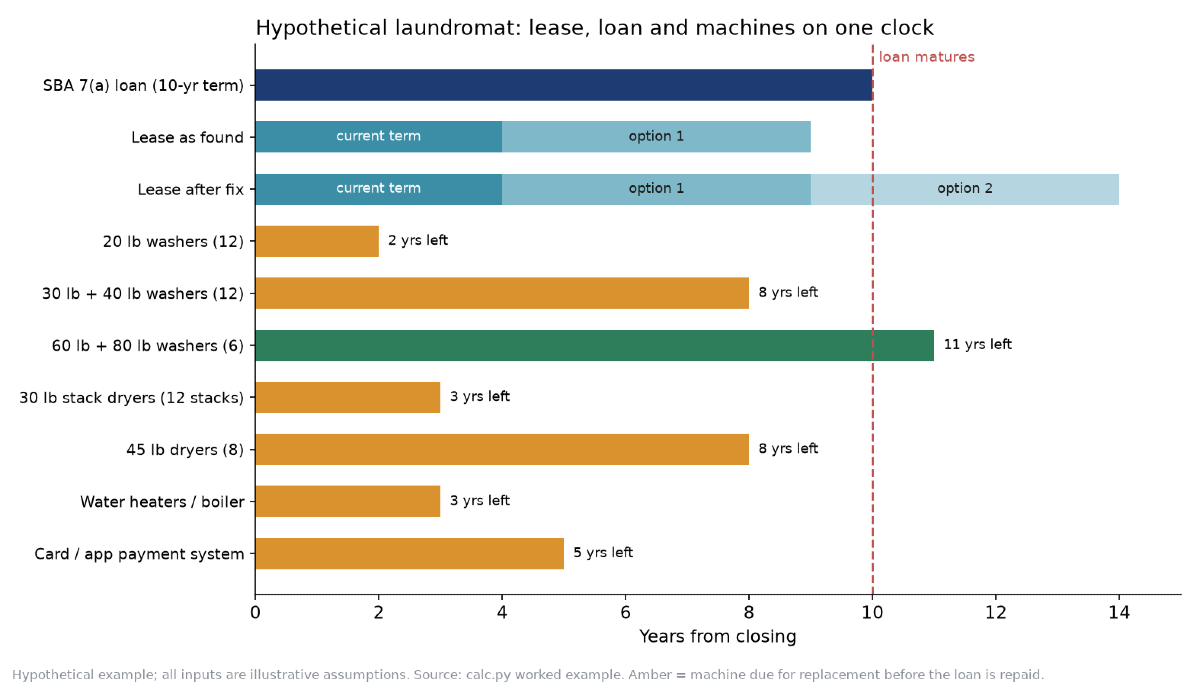
The hypothetical store fails as found. It has 4 years left plus one 5-year option, 9 years in total, against a 10-year loan. The fix is to get the landlord to agree to a second 5-year option, or a new lease, as a condition of closing. That makes 14 years. The fix comes with a price: the first option resets rent to 10% above the last lease-year rent, so in loan year 5 rent jumps from $76,709 to $84,380 instead of rising 3%.
Clock 2: do the machines outlast the loan?
A coverage test built on historical cash flow doesn't necessarily include a replacement reserve; that depends on the lender's credit policy. The machines wear out regardless. Here is the hypothetical fleet, with installed replacement costs in 2026 dollars (assumptions; get distributor quotes) and expected lives for the washers, dryers and water heaters inside the CLA's 10 to 15 year band (the card system, which the CLA list doesn't cover, gets 8 years):
| Equipment | Replacement cost | Age at closing | Expected life | Years left | Replaced in loan year |
|---|---|---|---|---|---|
| 20 lb washers (12) | $90,000 | 10 | 12 | 2 | 3 |
| 30 lb + 40 lb washers (12) | $138,000 | 6 | 14 | 8 | 9 |
| 60 lb + 80 lb washers (6) | $126,000 | 3 | 14 | 11 | after the loan |
| 30 lb stack dryers (12 stacks) | $114,000 | 11 | 14 | 3 | 4 |
| 45 lb dryers (8) | $56,000 | 6 | 14 | 8 | 9 |
| Water heaters / boiler | $32,000 | 9 | 12 | 3 | 4 |
| Card / app payment system | $22,000 | 3 | 8 | 5 | 6 |
| Total | $578,000 |
Of the $578,000 fleet, $452,000 falls due inside the 10-year loan in today's dollars, and $236,000 of it in the first four years. Spread over the loan, that is $45,200 a year. A straight-line reserve (each group's cost divided by its life) gives a similar $43,917. Deduct the $45,200 and the cash available for debt service falls from $97,706 to $52,506.
What price can a buyer support?
Assumptions: 10% equity on total project cost (the SOP 50 10 8.1 minimum for an initial acquisition), a 10-year term, a 10.00% rate, the FY2027 upfront guaranty fee (3% of the 75% guaranteed portion on loans of $150,001 to $700,000; NAGGL summary of SBA's FY2027 fee notice), $20,000 of closing costs and $15,000 of working capital. The SOP's minimum debt service coverage for an initial acquisition is 1.25.
| Price basis | Purchase price | x SDE | Loan | Annual debt service |
|---|---|---|---|---|
| 1.25x on lender cash flow ($97,706), no reserve | $501,579 | 3.80x | $492,902 | $78,165 |
| 1.00x after the $45,200 reserve | $325,439 | 2.46x | n/a | n/a |
| 1.25x after the $45,200 reserve | $253,351 | 1.92x | $264,880 | $42,005 |
At BizBuySell's multiples:
| SDE multiple | Price | DSCR, lender cash flow | DSCR after reserve |
|---|---|---|---|
| 2.72x (lower quartile) | $359,111 | 1.70x | 0.91x |
| 3.50x (median) | $462,091 | 1.35x | 0.73x |
| 4.12x (2025 average) | $543,947 | 1.16x | 0.62x |
| 4.50x (upper quartile) | $594,117 | 1.07x | 0.57x |
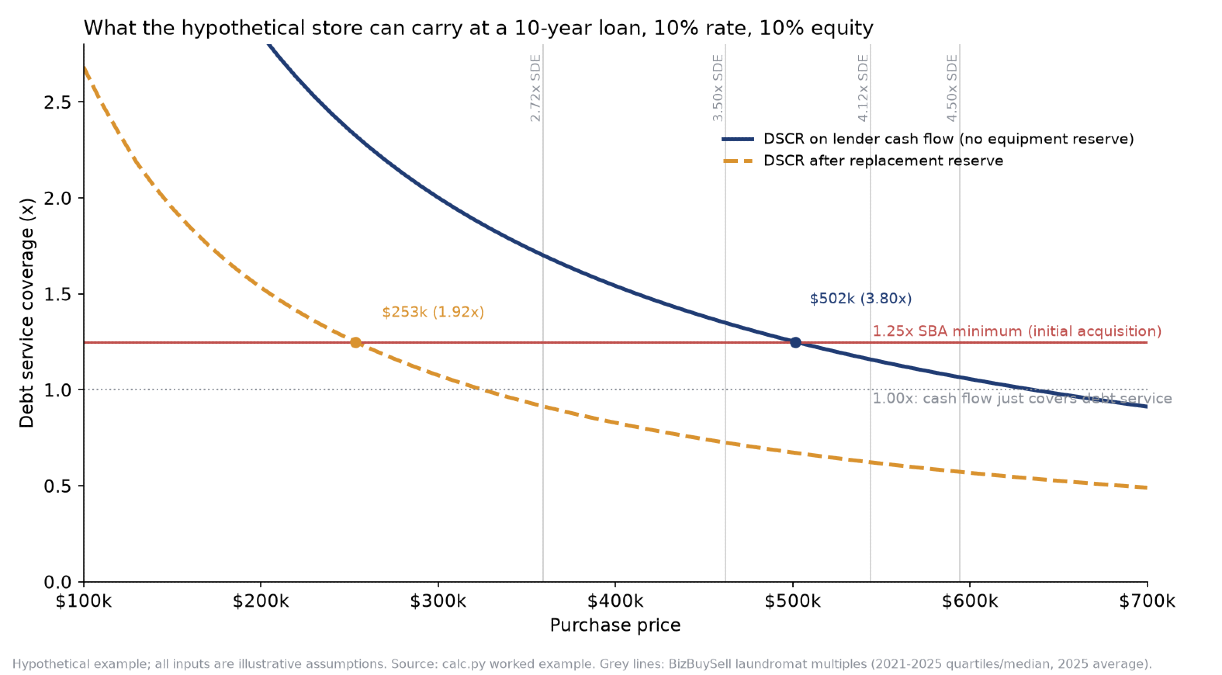
The lender test alone supports about $502,000, or 3.80x SDE, between BizBuySell's 3.50x median and 4.50x upper quartile. The fleet says something else. Buy at $502,000 and coverage stays at about 1.25x or better in every year of the loan. But if you pay for the machines out of cash flow (with revenue, costs and machine prices all growing 2.5% a year), you are short $70,851 in year 3 and $131,345 in year 4. Cumulative cash bottoms out at -$287,333 in year 9, when the mid-size washers and the 45 lb dryers come due.
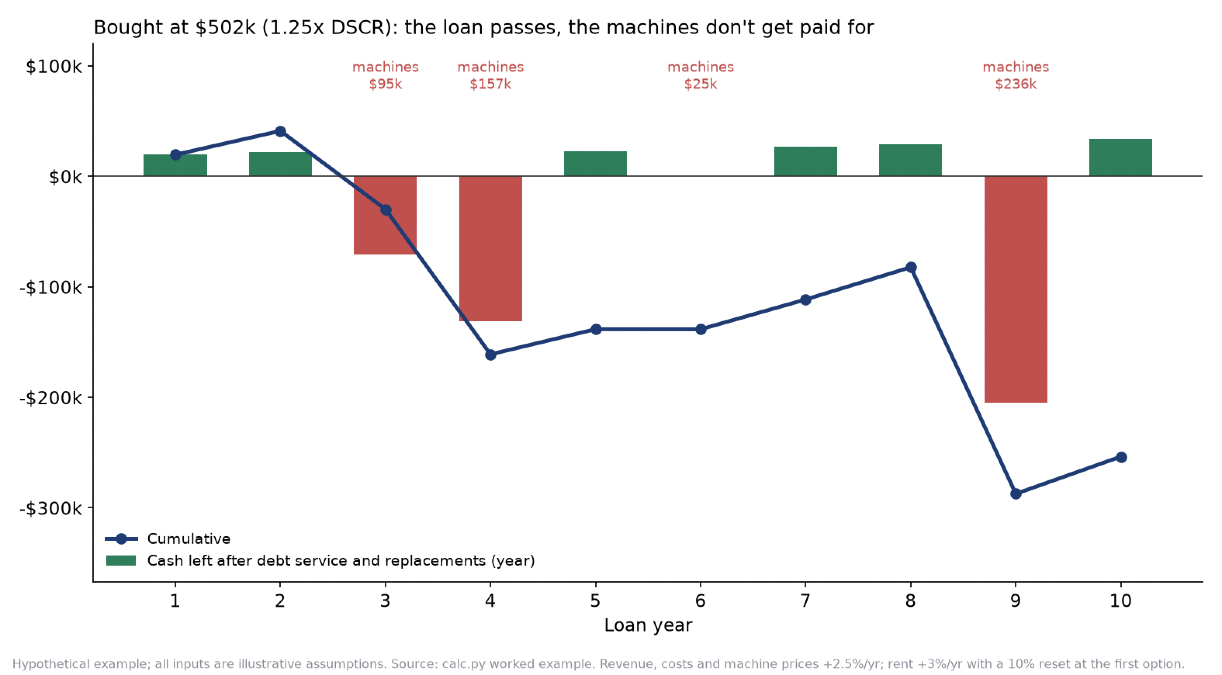
So the fleet's age belongs in the price. Compare the same store with every machine 2 years old at closing. Only the payment system comes due inside the loan ($22,000), and 1.25x supports about $489,000 even after that reserve. The gap between the two stores is roughly the cost of the machines due in the first four years. Use it in negotiation in one of four ways:
- Lower price.
- Seller credit for specific machines.
- A seller note (see how seller notes on full standby interact with SBA equity).
- A plan to finance replacements. New equipment debt adds debt service, so test it.
Sensitivity: what breaks the loan at $502,000
| Scenario | DSCR (lender cash flow) |
|---|---|
| Base case | 1.25x |
| Water bills 10% below the machine model (self-service revenue -$30,353) | 0.87x |
| Revenue -10% | 0.80x |
| Utilities +25% | 1.09x |
| Rent 10% higher from day one | 1.16x |
| Rate +1 point (11.00%) | 1.20x |
Revenue only has to fall 5.5% to take coverage to 1.00x. A store priced at the lender's limit has almost no room for error. That is why the water check comes before the letter of intent, not after. If the water bills support 10% less self-service revenue, the lender-supported price drops to about $337,543.
Due diligence specific to a laundromat
- Machine list from the floor, not the listing. Record make, model, capacity, serial number (the manufacturer can often date a machine from it) and condition for every washer, dryer pocket and water heater. Check each against the service log.
- 24 months of water and sewer bills from the utility, plus any sewer surcharges. Rebuild gallons by machine using the spec sheets and compare. Ask about leaks, meter changes and price increases in that period.
- Gas and electric bills for the same 24 months. Rising gas use with flat revenue can point to a failing water heater or dryer burners.
- Card/app system reports and coin counts reconciled to bank deposits, month by month, for the same period as the tax returns.
- Vend price history with dates, so you can match revenue jumps to price changes.
- The lease, read for: remaining term; options exercisable only by the tenant; whether options survive assignment; landlord consent and fees for assignment; the landlord's waiver; option rent (fixed or "fair market"); NNN reconciliations; relocation or demolition clauses; an exclusive-use clause that keeps a competing laundry out of the center; and who pays for sewer lines, grease traps and slab repairs.
- Wash-dry-fold and commercial accounts: customer list, contracts, pricing and who does the work. If the seller does WDF personally, add labor.
- Competition and demographics: other laundromats within a short drive, new apartment buildings with in-unit laundry, and the renter share nearby. The CLA notes that coin laundries "perform exceptionally well in predominately renter-occupied, densely populated areas."
How to run this on a real store
Our Laundromat Acquisition & Underwriting Model ($99) follows the same order. According to the product page, it builds machine-level revenue group by group (washer and dryer counts × turns per day × vend price). It calculates an age-based capex reserve from remaining life and replacement cost per equipment group, and reconstructs SDE with the implied multiple. It tests DSCR on cash flow after owner pay and reserves against the 1.25x gate, and adds cash-on-cash, a 5-year IRR and sensitivity grids for revenue and utility-cost shocks. You enter the asking price, the machine fleet and the lease. It is a 10-sheet Excel workbook that also works in Google Sheets and comes with a 16-page PDF guide. The water-bill cross-check and the lease-term test above are checks you run alongside it. It is a planning tool: it does not get a loan approved, and its outputs are only as good as the inputs.
The short answer
In this hypothetical example, the laundromat has $359,721 of revenue and $132,026 of SDE. After paying someone for the owner's hours, $97,706 is left to service debt, which supports about $502,000 (3.80x SDE) at 1.25x on a 10-year SBA 7(a) loan at 10%. But the lease as found runs 9 years against a 10-year loan, and $452,000 of machines come due before the loan is repaid. After a reserve for those machines, the price that keeps 1.25x is about $253,000 (1.92x). Before you make an offer on a laundromat:
- Fix the lease term so it covers the loan.
- Rebuild revenue from the machines and check it against the water bills.
- Price the fleet's age into the deal.
Disclaimer: This article is for educational purposes only and is not financial, investment, lending, legal or tax advice. The laundromat, its figures and all scenarios are hypothetical and were built to illustrate the math. They are not benchmarks, and they do not describe any real business, listing or transaction. SBA rules, fees and rates change, and lenders apply their own credit policies on top of SBA requirements. Whether the SOP lease-term rule applies to a given loan is the lender's determination. No model or article can get a loan approved. Verify every figure against the seller's tax returns, bank statements, utility bills, equipment records and lease, your lender's term sheet and the current SBA SOP. Consult qualified professionals, including a real estate attorney for the lease, before buying a business.
Keep reading
You might also like
How Much Does a Boutique Fitness Studio Make? A Buyer's Math
Most answers to "how much does a boutique fitness studio make" give a revenue range and a margin band. This guide rebuilds a hypothetical 12-reformer Pilates studio from its timetable, fill rate, memberships, class packs and instructor pay, turns that into SDE and the cash a lender counts, and works out what price an SBA 7(a) buyer can support, with stress tests for churn, a departing instructor, a new competitor and a rent reset.
How to Analyze a Self-Storage Deal: Rent Roll, NOI, Taxes and Debt, Worked Example
A self-storage offering memorandum often shows the seller's NOI: no management fee, no reserve and an old tax bill. This guide rebuilds a hypothetical 500-unit facility from its rent roll, reprices the expenses a buyer will actually carry, values the NOI at a cap rate and tests the debt, with stress tests for occupancy, rates, taxes and interest.
How Much Does an HVAC Business Make, and What Can a Buyer Afford to Pay?
Most answers to "how much does an HVAC business make" give you a revenue range and a profit percentage. This guide rebuilds a hypothetical residential HVAC company from its four revenue lines, technicians and overhead, turns that into SDE and lender cash flow, and then works out what price an SBA 7(a) buyer can actually support, with stress tests for a mild summer and a lost lead tech.