Independent Auto Repair Shop Acquisition & SBA Underwriting Financial Model
Buy an independent auto repair shop with your eyes open: revenue built from bays, techs and billed hours at the rate the shop actually collects ($118, not the $140 on the sign), a real SBA…
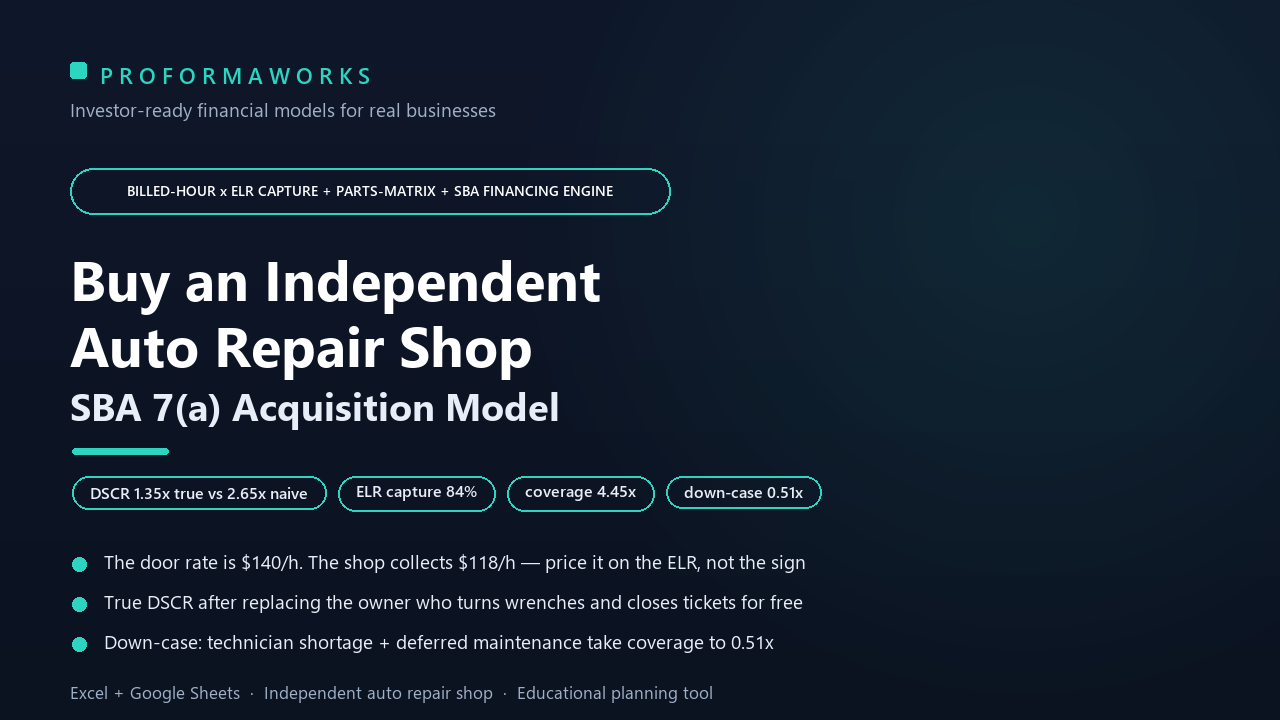
Most auto repair templates are startup or operating forecasts: you type a revenue number and grow it 5% a year. This is the first acquisition-underwriting model for auto repair — built for the searcher, the ETA buyer or the first-time owner-operator who is buying one independent shop with an SBA 7(a) loan and has to prove to a lender that it services its debt.
The engine. Labor revenue is manufactured from physical capacity, not typed in: 4 technicians × 8,000 available hours × a 63.6% overall utilization (productivity × efficiency) = 5,085 billed hours, priced at the effective labor rate. Parts run off a parts-to-labor ratio at their own matrix margin. The result is cross-checked two independent ways — 2,400 repair orders at a $525 ARO, and 2.12 hours per RO.
The number that decides the deal. A shop's posted door rate is not what it collects. Discounts, giveaway diagnostics, comebacks and unbilled hours drag $140 down to $118.02 — an 84.3% capture. Underwrite at the sign and you overstate labor revenue by $111,870, which at a 60% labor margin drops $67,000 straight onto SDE. Price that at 2.75× and the shop "costs" $773,469 instead of $589,059. The model prints both prices side by side: the gap is $184,410 — 31.3% of the purchase price.
The add-back the seller's sheet skips. In most independent shops the owner is the A-tech on the hard diagnostics or the advisor who closes the estimates. If you won't stand in that bay, you hire it ($75,000). Deduct that, reserve $18,000 a year for lifts, alignment racks and scan tools, and the true DSCR is 1.35× — against the 2.65× naive figure a broker's add-back sheet implies. The gap is the owner's own labor.
An honest down-case. In this business revenue *is* a technician's hour, and the industry fills roughly 71% of technician demand (TechForce, ~20,780 needed a year). Car count −8% plus a 4% rate discount to hold volume takes DSCR to 0.51× — far below the 1.25× SBA program floor. The model also shows what losing one of four techs does: 25% of billed hours, gone.
Three profiles, one file. Tire-and-Service Volume (2.40×), General Repair (2.75×, base), Euro/Import Specialist (3.25×). The tire shop books an 11.8% bigger top line on a *thinner* SDE margin — tires are pass-through. Read the shop on the gross profit, not the revenue.
Honest by construction. SDE is held at 17.0% and Adjusted EBITDA at 9.6% — deliberately below the "15-20% net" of trade blogs, because that's what's left once the owner is paid for. The equity multiple (3.12×) is labelled leverage-amplified. There is no IRR: on one small deal it's hostage to the exit multiple.
Includes an 11-sheet Excel workbook (Google Sheets compatible — no macros, no add-ins), a PDF guide with sources, and a full sensitivity/stress set. Educational planning tool — not financial, lending or legal advice.