Powersports Dealership Acquisition & SBA Underwriting Financial Model
Underwrite a powersports dealership acquisition (moto / ATV / UTV / PWC / snowmobile) the way it really works: gross by department (new units, used, F&I, parts & service), an explicit…
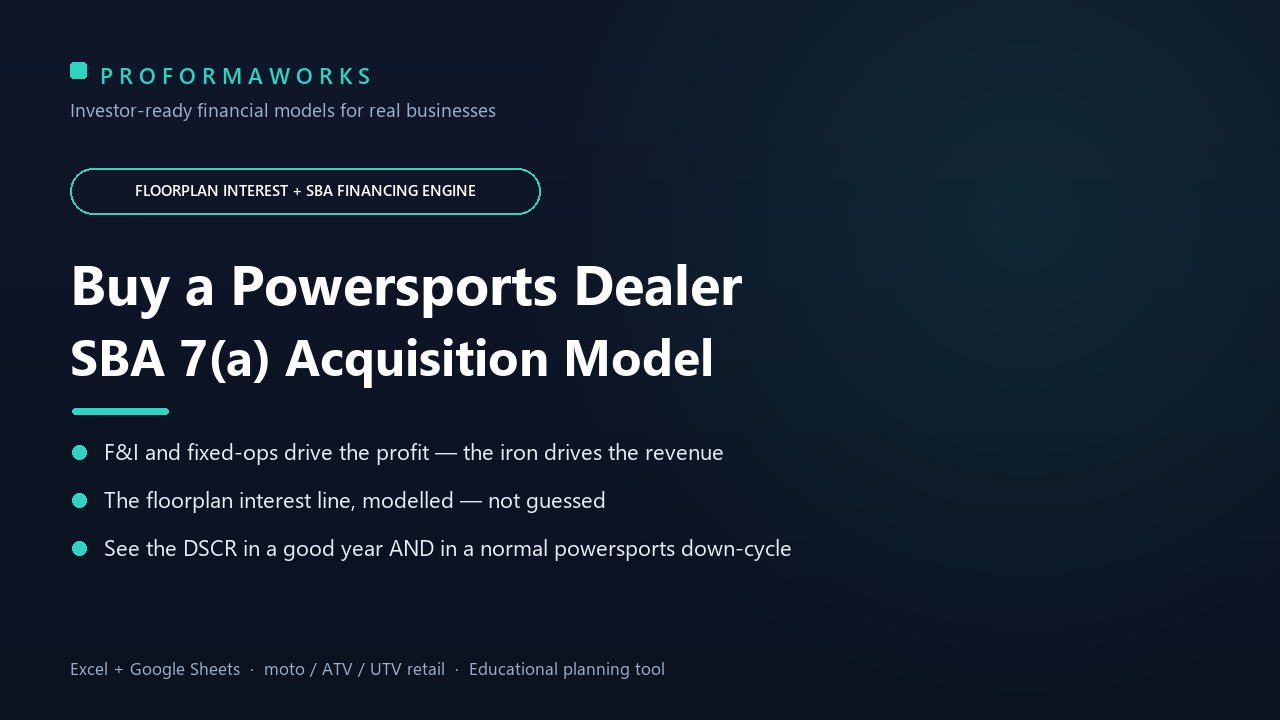
Underwrite a powersports dealership acquisition (moto / ATV / UTV / PWC / snowmobile) the way it really works — not as one revenue blob. A dealership is four businesses under one roof, and the iron is not where the money is. This is a lender-ready, 5-year model for buying a single-store powersports dealership with an SBA 7(a) loan, built around the two lines no existing template models: the unit floorplan interest and the fixed-ops absorption ratio. The template market has plenty of "how to start a dealer" operating forecasts — this is the acquisition underwrite.
The engine. Revenue and gross are built bottom-up by department — new units, used units, F&I (per deal × finance penetration) and parts, gear & service — each at its own margin, so Gross Profit falls out of the mix. In the base case the new and used iron make ~72% of the revenue while F&I and fixed-ops make ~60% of the gross profit. That is the honest dealership thesis, and the model prices it. The revenue split tracks the public powersports consolidators (RideNow Q2-2025: new ~52% / used ~20% / parts & service ~18% / F&I ~9%), with a thin ~13% new-unit gross margin.
The floorplan, modelled explicitly. Unit inventory is financed on a revolving floorplan line (Wells Fargo CDF, Sheffield, Polaris Acceptance — ~100% of invoice at ~7–10%), kept separate from the acquisition loan. Floorplan interest = average inventory at cost × advance rate × floorplan rate, where average inventory = unit cost × days-in-stock ÷ 365. Powersports turns fast (moto ~6–10×, ATV/UTV ~6–8×), so the carrying cost is small in a good year — but days-in-stock and the floorplan rate are stressable drivers, and aging inventory in a soft market is exactly what turns a profitable lot into a loss.
The honest headline: the down-cycle. The base-case DSCR looks comfortable at 1.65x — because the acquisition loan is small versus cash flow; the inventory risk lives in the floorplan, not the loan. So the model runs the test the seller’s good-year P&L never will: a normal powersports down-cycle (−20% unit volumes — in 2008–09 on-road units fell up to −44% and units/parts/service −20%+; motorcycles fell ~8% in 2025) through the fixed overhead, which cuts SDE by ~34% and drops DSCR to 0.88x. Powersports are discretionary and cyclical; the bankable story is fixed-ops absorption + floorplan discipline + the down-cycle, not a leverage-amplified cash-on-cash.
What you get: an 11-sheet Excel workbook (works in Google Sheets — no macros, no add-ins, no external links), a PDF user guide, a 3-way profile toggle (off-road & ATV/UTV / on-road & V-twin / used & fixed-ops heavy), an SBA 7(a) capital stack with the 10% injection and $5M-cap checks, a real amortisation schedule, the fixed-ops absorption ratio (62.1% in the base case — below the ~64% average, which is the buyer’s value-add lever), the floorplan interest coverage, a DSCR stress grid across days-in-stock × floorplan rate, and a conservative 5-year exit with the equity multiple. Every formula is recomputed by three independent engines (67/67 checks pass).
Honest by design. SDE margin is held at a realistic ~7.9% (powersports dealers run thin); units-per-store and the revenue split are industry-representative estimates drawn from RideNow / OneWater public filings and real BizBuySell listings; the cash-on-cash and equity multiple are stated as leverage-amplified and cyclical; there is deliberately no IRR. Educational planning tool — not financial, investment, tax or lending advice. Verify the seller’s tax returns, the floorplan agreement and your SBA term sheet before relying on any number.