How Much Does a Boutique Fitness Studio Make? A Buyer's Math
Search "how much does a boutique fitness studio make" and you get ranges, not answers. Transaction data is more modest than the "20% to 40% margin" claims on software blogs. Across gyms and fitness centers sold on BizBuySell from 2021 through 2025, median revenue was $400,000 and median owner earnings were $99,389, or 24.8% of revenue before the owner is paid anything. In BizBuySell's narrower "Dance, Pilates and Yoga Studios" category, the medians were $281,709 of revenue and $77,500 of earnings (BizBuySell gym and fitness center benchmarks, as shown on November 21, 2026). Franchised studios run larger. Xponential Fitness, which franchises Club Pilates, Pure Barre, YogaSix and other brands, reported a trailing-12-month average unit volume of $673,000 for its North American studios as of September 30, 2026, down from $701,000 a year earlier (Xponential Q3 2026 Form 10-Q).
Owner earnings, or seller's discretionary earnings (SDE), adds back the seller's pay, perks, interest, depreciation and one-time costs. In a studio it usually hides something else: classes the owner teaches for free. A buyer needs the cash left after every class and a manager are paid, the reformers are replaced and the loan is serviced.
This article builds that number for a clearly hypothetical independent reformer Pilates studio, then works out what price it can support with an SBA 7(a) loan. Every input is an assumption unless it links to a source.
What the top answers cover, and what they leave out
The pages that rank for this question give revenue bands, margin percentages and owner-income ranges. The most data-based is the BFS Network's recap of its 2024 survey of independent studios: "the majority of studios (profitable or not) make under $500K annually," and profitable studios mostly have "a profit margin between 1-19%" (BFS Network). What is usually missing is the mechanics behind those numbers:
- Capacity. Reformers × classes × fill sets the ceiling on visits.
- Where the seats go. Members, class packs, drop-ins and intro offers pay very different prices per visit.
- Churn. The member base is set by how many people join each month and the share who leave.
- The owner's real job. Many sellers teach part of the timetable and run the studio. SDE treats both as free.
- Price capacity. SBA lenders test coverage on cash flow after the jobs the seller did for free are paid.
What the public data says first
Instructor pay. The Bureau of Labor Statistics reports that "the median annual wage for fitness trainers and instructors was $47,160 in May 2025," or $22.67 an hour. "The lowest 10 percent earned less than $28,800, and the highest 10 percent earned more than $83,100" (BLS Occupational Outlook Handbook). Studios often pay per class, so treat the hourly figure as a reference point, not a rate card.
Margins. The Health & Fitness Association's 2026 benchmarking report, built on 2025 data from 244 operators "representing nearly 27,000 fitness facilities across 40 countries," found a median EBITDA margin of 22.1% (HFA). The median pre-tax earnings margin was 12.0%, and the median payroll ratio was 36.4% of revenue, or 39.2% for single-site operators (HFA 2026 Global Report, Operator Snapshot). HFA's sample covers fitness operators of all types and sizes, not just boutique studios, so treat these figures as context, not a studio benchmark.
Churn. In the BFS survey, "62% of all profitable studios reported churn below 5%" (BFS Network). As you will see below, one percentage point of churn can decide whether a deal works.
Sale prices. For gyms and fitness centers sold on BizBuySell in 2021 to 2025, SDE multiples had a lower quartile of 1.72, a median of 2.42, an average of 2.55 and an upper quartile of 3.00. "Dance, Pilates and Yoga Studios" averaged 2.07. BizBuySell says higher multiples for higher-revenue gyms are "largely driven by the economics of business acquisition financing" (BizBuySell). A boutique-fitness M&A advisor writing in Athletech News in October 2026 says single-location studios with $100,000 or more in earnings "usually sell for 2x to 3x, and our median is closer to 2x." On earnings, the advisor writes: "If the owner teaches, those classes are costed at instructor pay" (Athletech News). That is one firm's experience, not a dataset.
The hypothetical studio: 12 reformers, 46 classes a week
Our example is an independent reformer Pilates studio in a suburban strip center: 2,200 square feet, 12 reformers, 46 classes a week, 50 weeks a year. (Xponential says a typical Club Pilates studio is "designed to allow usually up to 12 people to work out together," per its FY2025 Form 10-K.) The seller manages the studio and teaches 8 of the 46 weekly classes.
Revenue assumptions
- Memberships: 165 members. 40 unlimited at $249 a month (about 9.5 visits a month), 85 on 8 classes a month at $199 (6.5 visits), 40 on 4 classes at $135 (3.5 visits).
- Class packs: 3,000 visits a year from a 10-class pack sold at $290, or $29 a visit.
- Drop-ins: 800 visits at $38.
- Intro offer: 420 new students a year buy "3 classes for $59."
- Private sessions: 10 a week at $95. Retail: $12,000 a year at a 50% cost of goods.
Where the seats go
| Buyer type | Visits a year | Share of seats | Revenue | Revenue per visit |
|---|---|---|---|---|
| Members | 12,870 | 46.6% | $387,300 | $30 |
| Class packs | 3,000 | 10.9% | $87,000 | $29 |
| Drop-ins | 800 | 2.9% | $30,400 | $38 |
| Intro offers | 1,260 | 4.6% | $24,780 | $20 |
| Empty seats | 9,670 | 35.0% | $0 | — |
| Total | 27,600 seats | 100% | $529,480 | $30 per filled seat |
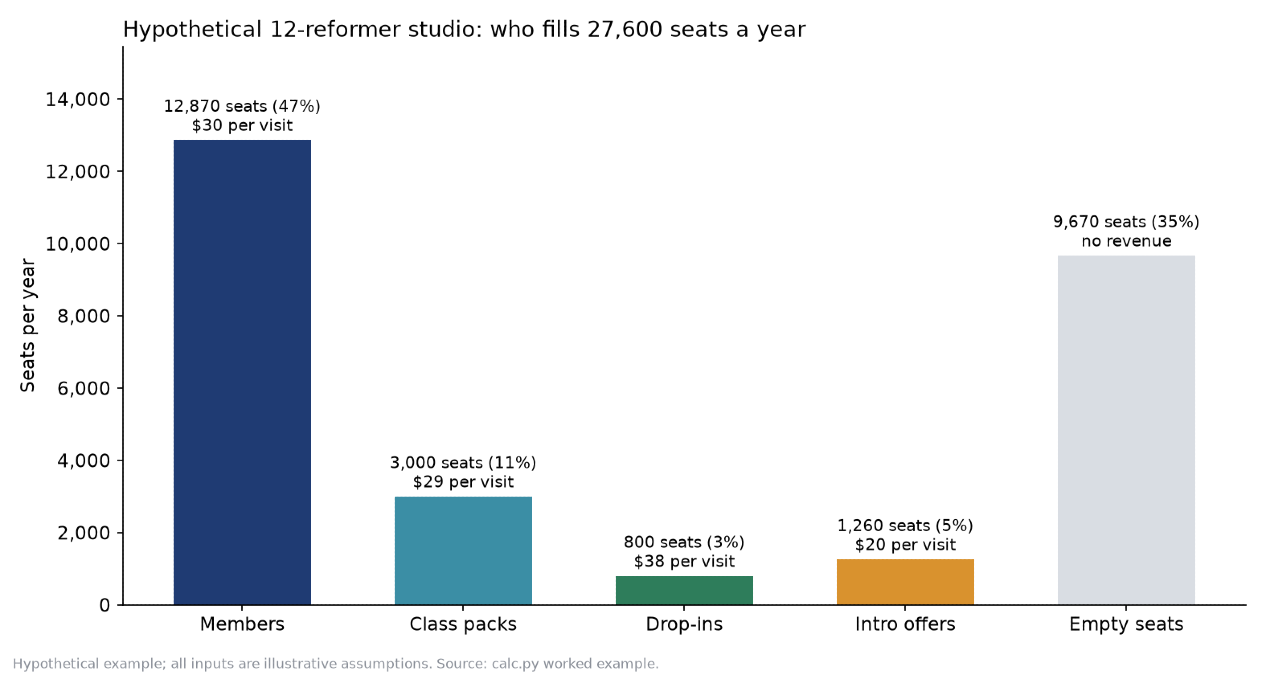
The studio is 65% full, or 7.8 people in a 12-reformer class, and each class brings in about $230. An instructor at an assumed $50 a class plus a 10% payroll burden costs $55, about $7 per person in the room. The other $23 of each $30 visit goes to rent, the front desk and everything else, so fill matters more than price.
The unlimited member is the cheapest visit: $26.21 at 9.5 visits a month, against $38.57 on the 4-class plan. A seller who grew by pushing unlimited plans may have filled classes without raising revenue per seat. Intro offers fill seats at $20 a visit. They are worth only as much as the share of intro students who become members.
Total revenue is $588,980: memberships 65.8%, packs 14.8%, drop-ins 5.2%, intro offers 4.2%, privates 8.1% and retail 2.0%.
Churn decides the member base
Members leave every month. At an assumed 4% monthly churn, 165 members means 6.6 cancellations a month, or 79 a year. Just to stand still, the studio needs 79 new members from its 420 intro students, an 18.9% conversion rate. The average member stays 25 months.
Turn that around and the member base is just monthly new members ÷ monthly churn. Keep the same intake and change only churn:
| Monthly churn | Steady-state members | Membership revenue | Lender-adjusted EBITDA* |
|---|---|---|---|
| 3% | 220 | $516,400 | $219,035 |
| 4% (base) | 165 | $387,300 | $101,554 |
| 5% | 132 | $309,840 | $31,066 |
| 6% | 110 | $258,200 | −$15,927 |
*Defined in the next section. Instructor pay, rent and the timetable are held constant.
Conversion works the same way: at 15% instead of 18.9%, the base settles at 131 members. Ask the seller for 24 months of member counts, joins and cancellations from the booking software, not a single headcount.
Instructors, rent and the seller's P&L
The 38 classes a week the seller does not teach cost $95,000 a year at $50 a class. Private-session instructors keep half of each $95 session, or $23,750. Front-desk coverage of 50 hours a week at $17 an hour is $44,200. We add a 10% burden for payroll taxes and workers' comp; employer FICA alone is 7.65% (IRS Publication 15). Total staff cost is 30.4% of revenue, below HFA's 36.4% median payroll ratio, partly because the seller's teaching and management are not in it.
For a 50-minute class, $50 is 2.2 times the BLS median hourly wage, a premium for prep time and reformer certification. Use the rate the seller actually pays. If the seller pays instructors as 1099 contractors, ask an employment professional whether that holds up, because reclassifying them adds employer payroll taxes. Rent is assumed at $36 per square foot gross, or $79,200 (13.4% of revenue). Marketing is 6% of revenue, card processing 3%, and other overhead $69,000.
| Step | Amount | % of revenue |
|---|---|---|
| Revenue | $588,980 | 100.0% |
| − Instructor pay and retail cost of goods | −$124,750 | −21.2% |
| − Overhead (rent, desk, burden, marketing, other) | −$261,703 | −44.4% |
| − Owner salary, payroll tax, health, perks | −$72,708 | −12.3% |
| − One-time floor repair | −$9,000 | −1.5% |
| = EBITDA as reported | $120,819 | 20.5% |
| − Depreciation and interest | −$27,500 | −4.7% |
| = Net income before tax | $93,319 | 15.8% |
| + Depreciation, interest, owner costs, one-time item | +$109,208 | 18.5% |
| = SDE (broker view) | $202,527 | 34.4% |
| − Instructor pay for the seller's 400 classes a year | −$22,000 | −3.7% |
| − Market pay for the buyer as studio manager | −$78,972 | −13.4% |
| = Lender-adjusted EBITDA | $101,554 | 17.2% |
| − Equipment replacement reserve | −$12,000 | −2.0% |
| = Cash flow available for debt service | $89,554 | 15.2% |
So what does this studio "make"? It depends on who is asking:
- The seller received $166,027 a year: $72,708 in salary, payroll tax, health insurance and perks plus $93,319 of pre-tax profit.
- The broker will market $202,527 of SDE, a 34.4% margin, well above BizBuySell's 24.8% five-year gym median, partly because the seller teaches 8 classes a week for free.
- The buyer has $101,554 after paying for those classes and a $65,000 manager salary with payroll tax and health insurance, and $89,554 after an equipment reserve (12 reformers at an assumed $7,500, replaced over 10 years, plus $3,000 a year).
Why both adjustments go in. Under SBA's SOP 50 10 8.1, historical debt service coverage is "EBITDA divided by the combined debt service post-transaction." Lenders may adjust for items such as "Unfunded capital expenditures" and "Ownership Compensation," but must justify each one, and "the ownership compensation of the Applicant must be sufficient to support their current obligations and living expenses" (SBA SOP 50 10 8.1, Appendix 15). Our walkthrough of how an SBA lender rebuilds SDE covers which add-backs survive. If you will teach the seller's classes yourself, you keep the $22,000, but you are also buying a job.
What price can the buyer support with SBA 7(a) debt?
An outside buyer of 100% of the studio is an "Initial Acquisition" under SOP 50 10 8.1 Appendix 15 (full rule set in our guide to SBA 7(a) rules for business buyers after October 1, 2026). The rules that set price here:
- Equity: "Initial Acquisition: 10%" of total project cost, which "cannot be reduced or eliminated."
- Coverage: "Initial Acquisition: 1.25:1," on the last fiscal year-end or the average of the last two. Lenders "may not rely on" projections to meet it.
- Term: change-of-ownership loans "must not have an amortization that exceeds 10 years."
- Rate: every loan in the main example is above $350,000, where SBA's maximum variable rate is prime plus 3%. With prime at 7.00% in the Federal Reserve H.15 release dated November 20, 2026, that is 10.00%, our conservative assumption: a ceiling, not a quote.
- Fees: a 75% guaranty (the SOP Appendix 16 maximum over $150,000) and the fiscal 2027 upfront fee of "3% of the guaranteed portion" for loans of $150,001 to $700,000 (NAGGL summary of SBA's FY2027 fee notice), financed in the loan.
- Lease: for 7(a) loans "the lease term, including renewal options exercisable only by the Borrower, should equal or exceed the term of the loan" (SOP 50 10 8.1). Three years left with no options is a problem.
Deal assumptions: project cost is the price plus $22,000 of closing costs, $25,000 of working capital and the fee; the buyer puts in 10%. Each $100,000 borrowed costs $15,858 a year.
Price at common SDE multiples
| SDE multiple | Price | Equity (10%) | Loan | Annual debt service | DSCR on EBITDA | DSCR after reserve |
|---|---|---|---|---|---|---|
| 1.72x | $348,346 | $40,352 | $363,166 | $57,591 | 1.76x | 1.56x |
| 2.07x | $419,230 | $47,587 | $428,280 | $67,917 | 1.50x | 1.32x |
| 2.42x | $490,115 | $54,822 | $493,395 | $78,243 | 1.30x | 1.14x |
| 2.55x | $516,443 | $57,509 | $517,580 | $82,078 | 1.24x | 1.09x |
| 3.00x | $607,580 | $66,811 | $601,299 | $95,354 | 1.07x | 0.94x |
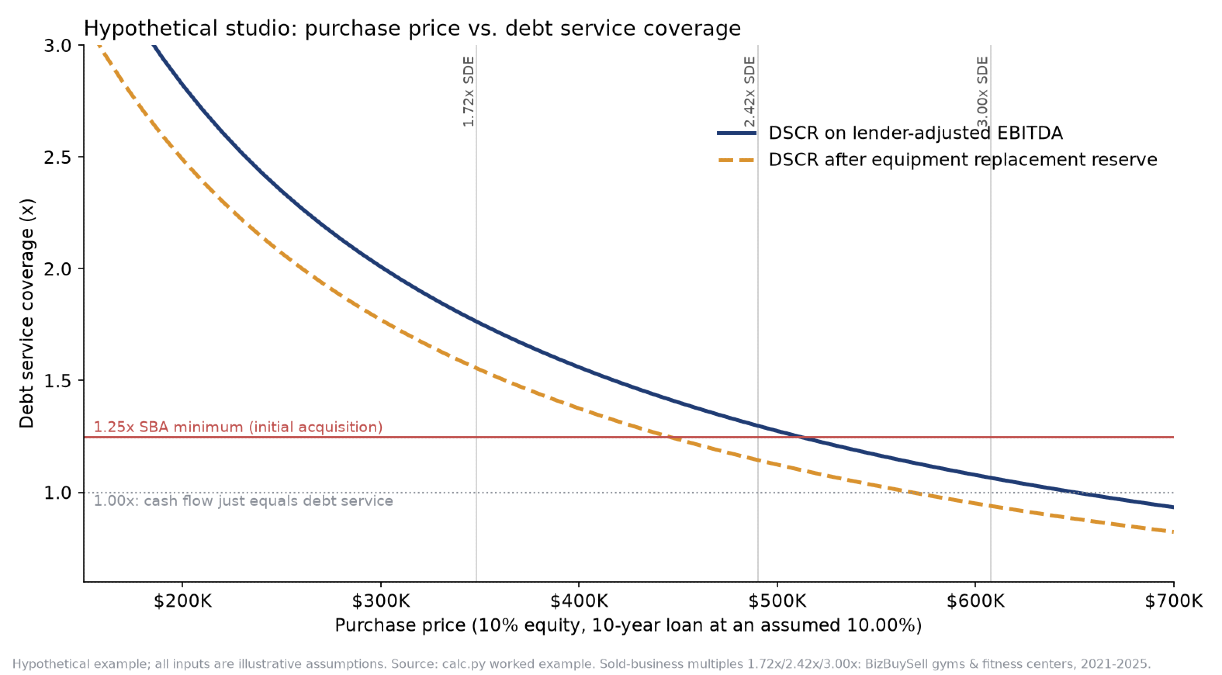
Solving for the highest price that still gives exactly 1.25x:
- On lender-adjusted EBITDA: a $512,315 loan and a price of $510,712, or 2.52x SDE, with $56,924 of buyer equity.
- After the equipment reserve: a $451,779 loan and a price of $444,811, or 2.20x SDE, with $50,198 of equity.
Treat the whole $202,527 of SDE as debt-service cash and the same math would "support" $1.06 million (5.24x). The seller's free teaching and your salary account for more than half of that figure.
At $510,712, the buyer earns a $65,000 salary plus $20,311 a year after debt service and before income tax, or $8,311 after the reserve. Rate sensitivity: at 9.00% the 1.25x price rises to $534,817 (2.64x); at 11.00% it falls to $488,042 (2.41x).
Fill rate: the number that breaks the deal
Instructor pay is per class and rent is fixed, so when attendance falls, revenue falls and costs don't.
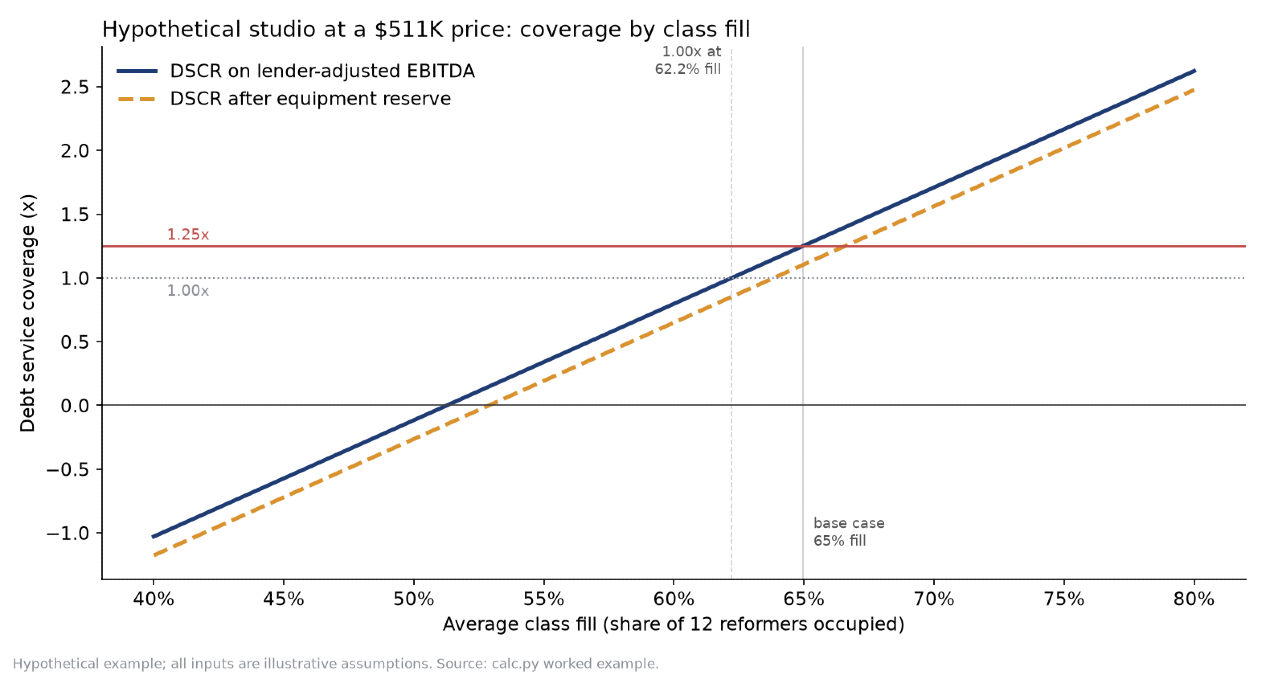
At the $510,712 price, coverage drops to 1.00x when average fill slips from 65.0% to 62.2%: 7.5 people per class instead of 7.8, or a 4.2% drop in group visits. At 51.3% fill, lender-adjusted EBITDA is zero before any debt service. These figures assume the timetable stays the same. Cutting classes saves instructor pay, but it takes time and tends to cost members.
Stress tests: how fragile is 1.25x?
Price fixed at $510,712; annual debt service $81,243.
| Scenario (assumptions) | Revenue | Lender-adjusted EBITDA | DSCR | DSCR after reserve |
|---|---|---|---|---|
| Base case | $588,980 | $101,554 | 1.25x | 1.10x |
| Churn rises from 4% to 4.5% a month (147 members) | $545,947 | $62,394 | 0.77x | 0.62x |
| Lead instructor leaves with 12% of members, packs and 15% of privates | $524,939 | $47,196 | 0.58x | 0.43x |
| New franchise studio nearby: intro students −25%, packs and drop-ins −15%, members −8% | $534,191 | $51,696 | 0.64x | 0.49x |
| Instructor pay rises from $50 to $60 a class | $588,980 | $76,254 | 0.94x | 0.79x |
| Lease renewal: rent from $36 to $44 per square foot | $588,980 | $83,954 | 1.03x | 0.89x |
| Churn 4.5% and instructor pay $60 | $545,947 | $37,094 | 0.46x | 0.31x |
The diligence list follows from these results:
- Members follow instructors. Ask for attendance by instructor, and find out whether the one with the waitlists will stay.
- Competition hits the top of the funnel first. A new studio shows up in intro sign-ups and pack sales months before member counts.
- The lease is part of the price. The Athletech advisor counts "the lease has years of runway and can be assigned" among the traits of studios that sell well. Get the landlord's consent and the renewal rent in writing.
- Prepaid visits. If members hold, say, 900 unused pack visits at closing, you inherit about $26,100 of classes the seller already collected cash for. Ask for a credit at closing.
Prices that leave a cushion
- Require 1.25x after the equipment reserve: $444,811 (2.20x SDE). Base DSCR on EBITDA is then 1.42x, and a half-point rise in churn takes it to 0.87x.
- Require the 4.5% churn case to stay at or above 1.00x: $381,316 (1.88x SDE).
If the asking price is above what the cash flow supports, a seller note can bridge part of the gap; our guide to seller notes on full standby explains how SBA treats them.
Buying a franchise studio instead
Xponential says it receives "approximately 7% and 2% of the sales by franchisees as royalty revenue and marketing fund revenue" (FY2025 Form 10-K). Put a 9% fee on our studio's sales and let local marketing fall from 6% to 3%: fees total $53,008, lender-adjusted EBITDA falls to $66,216, and the 1.25x price drops to $316,640. The loan at that price falls in SBA's $250,001 to $350,000 band, where the maximum variable rate is prime plus 4.5%, or 11.50%; we keep 10.00% so the two cases compare, but a lender could price this loan higher. To match the independent, the franchise unit needs about 7.9% more group volume (70.1% fill). The brand may deliver that; check the unit's own numbers. Athletech's advisor also notes that "the franchisor usually holds a right of first refusal and has to approve the buyer, and transfer fees and required updates come out of the deal."
How to run this on a real studio
- Rebuild the timetable: classes, capacity and fill by time slot for 12 to 24 months, with visits split by buyer type.
- Get the member flow: joins, cancellations and freezes by month, plus intro conversion.
- Price the owner's hours at market, teaching and management.
- Recast to lender EBITDA from tax returns, with documented add-backs and an equipment reserve.
- Read the lease and the prepaid-visit liability, then solve for price at 1.25x and stress it.
Our Boutique Fitness Studio Financial Model uses the same capacity logic. According to the product page, it builds revenue from seats × classes per week × fill, splits visits into membership revenue, class packs and drop-ins, and runs a Year-1 membership waterfall against your modality's churn, with presets for Reformer Pilates, Spin, Yoga/Barre and HIIT. It produces a 5-year P&L with SDE, payback, cash-on-cash, DSCR, breakeven fill and a 5-year IRR, in a 10-sheet Excel workbook that also runs in Google Sheets. It is designed for opening a studio. For a studio you are buying, enter the seller's timetable, prices and churn to test whether the reported revenue fits the schedule, and run the purchase-price math above alongside it. It is a planning tool: it does not get a loan approved, and its outputs are only as good as the numbers you put into it.
The short answer
In our hypothetical example, a 12-reformer studio with about $589,000 of revenue shows a 15.8% pre-tax margin, a 34.4% SDE margin and about $166,000 for the seller. For a buyer, the useful number is SDE minus market pay for the seller's teaching and management: $101,554 here. With 10% equity, a 10-year SBA 7(a) loan at an assumed 10.00% and a 1.25x test, that supports about 2.52x SDE, or 2.20x after an equipment reserve. Fill falling from 65% to 62%, or churn rising half a point, takes that price below 1.00x. Before you sign a letter of intent, find out whether the seller's timetable, member flow and lease support those numbers.
Disclaimer: This article is for educational purposes only and is not financial, investment, lending, legal, or tax advice. The fitness studio, its figures, and all scenarios are hypothetical and were built to illustrate the math; they are not benchmarks, and they do not describe any real business, brand, listing, or transaction. SBA rules, fees, and rates change, and lenders apply their own credit policies on top of SBA requirements. No model or article can get a loan approved. Verify every figure against the seller's tax returns, booking-system reports and financial statements, the lease, your lender's term sheet, and the current SBA SOP, and consult qualified professionals before buying a business.
Keep reading
You might also like
Buying a Laundromat: Does the Lease Outlast the SBA Loan, and Do the Machines?
Before buying a laundromat, put three clocks side by side: the lease, the 10-year SBA 7(a) loan and the machines. This guide rebuilds a hypothetical 30-washer store from vend prices and turns, checks that revenue against the water bill, tests the lease against SBA SOP 50 10 8.1, and shows how an aging fleet changes the price a buyer can support at 1.25x DSCR.
How to Analyze a Self-Storage Deal: Rent Roll, NOI, Taxes and Debt, Worked Example
A self-storage offering memorandum often shows the seller's NOI: no management fee, no reserve and an old tax bill. This guide rebuilds a hypothetical 500-unit facility from its rent roll, reprices the expenses a buyer will actually carry, values the NOI at a cap rate and tests the debt, with stress tests for occupancy, rates, taxes and interest.

How Much Does an HVAC Business Make, and What Can a Buyer Afford to Pay?
Most answers to "how much does an HVAC business make" give you a revenue range and a profit percentage. This guide rebuilds a hypothetical residential HVAC company from its four revenue lines, technicians and overhead, turns that into SDE and lender cash flow, and then works out what price an SBA 7(a) buyer can actually support, with stress tests for a mild summer and a lost lead tech.